I have taken a quotation, an...
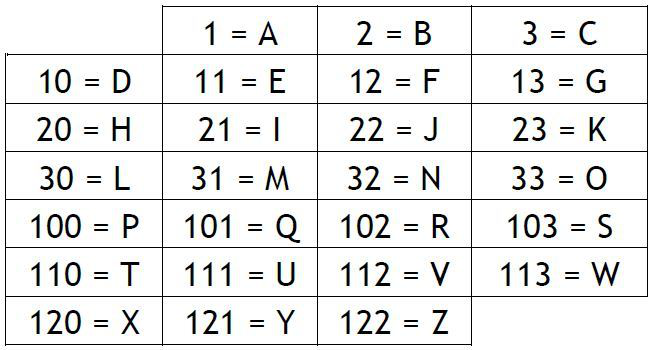
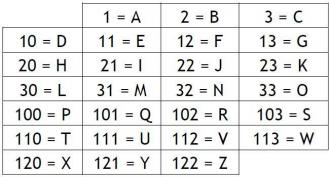
[2062] I have taken a quotation, an... - I have taken a quotation, and I have replaced each of the letters with one-, two- or three-digit numbers according to the table below. Can you change it back to letters? (2112 1110 1221102103110 12133111 103332110 10311133111110 313030 10110) - #brainteasers #wordpuzzles #riddles - Correct Answers: 39 - The first user who solved this task is llewellyn samuels
BRAIN TEASERS
enter your answer and press button OK

I have taken a quotation, an...

I have taken a quotation, and I have replaced each of the letters with one-, two- or three-digit numbers according to the table below. Can you change it back to letters? (2112 1110 1221102103110 12133111 103332110 10311133111110 313030 10110)
Correct answers: 39
The first user who solved this task is llewellyn samuels.
#brainteasers #wordpuzzles #riddles
Register with your Google Account and start collecting points.
Check your ranking on list.

Change

Don't change so people will like you. Be yourself and the right people will love the real you. Unless you are an asshole. Then you should change.

Jokes of the day - Daily updated jokes. New jokes every day.
Follow Brain Teasers on social networks

Brain Teasers

puzzles, riddles, mathematical problems, mastermind, cinemania...

Sir William Fairbairn

Died 18 Aug 1874 at age 85 (born 19 Feb 1789).(1st Baronet) Scottish civil engineer who was first to use wrought iron for ships, bridges, mill shafts, and structural beams. After moving to London in 1811, he invented a steam excavator and a sausage-making machine, but without commercial success. By 1817, he had established an engineering works in Manchester making mill machinery, which later made over 400 locomotives. The shipbuilding works he opened at Millwall, London (1835-49) built hundreds of iron boats. He furnished the rectangular wrought-iron tubes used by Stephenson for the Britannia railway bridge (1850) over the Menai Strait, which included two almost 460-ft (140-m) spans. He assisted James Joule and Lord Kelvin in geological investigations from 1851.«
This site uses cookies to store information on your computer. Some are essential to help the site properly. Others give us insight into how the site is used and help us to optimize the user experience. See our privacy policy.