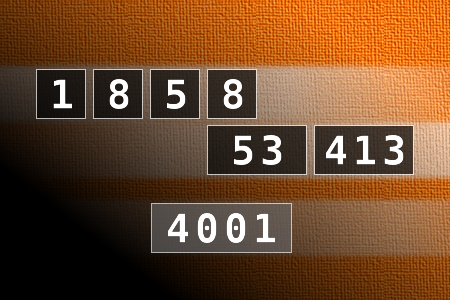
Calculate the number 4001
[4996] Calculate the number 4001 - NUMBERMANIA: Calculate the number 4001 using numbers [1, 8, 5, 8, 53, 413] and basic arithmetic operations (+, -, *, /). Each of the numbers can be used only once. - #brainteasers #math #numbermania - Correct Answers: 19 - The first user who solved this task is Djordje Timotijevic
BRAIN TEASERS
enter your answer and press button OK

Calculate the number 4001

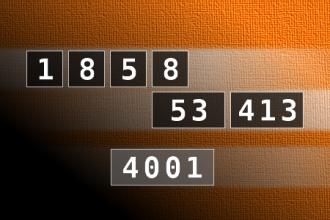
NUMBERMANIA: Calculate the number 4001 using numbers [1, 8, 5, 8, 53, 413] and basic arithmetic operations (+, -, *, /). Each of the numbers can be used only once.
Correct answers: 19
The first user who solved this task is Djordje Timotijevic.
#brainteasers #math #numbermania

Register with your Google Account and start collecting points.
Check your ranking on list.

The trick...

A little boy greeted his grandmother with a hug and said, "I'm so happy to see you, Grandma. Now maybe Daddy will do the trick he has been promising us."

The grandmother was curious. "What trick is that my dear?" she asked.

The little boy replied, "I heard Daddy tell Mommy that he would climb the walls if you came to visit us again."

Jokes of the day - Daily updated jokes. New jokes every day.
Follow Brain Teasers on social networks

Brain Teasers

puzzles, riddles, mathematical problems, mastermind, cinemania...

Transistor

In 1947, the transistor was first demonstrated by Walter H. Brattain and John Bardeen to their higher-ups at Bell Laboratories. A microphone and headphones were connected to the transistor, and the device was actually spoken over "with no noticeable change in quality" as Brattain wrote in his notes about that day. The name transistor came from its electrical property known as trans-resistance. The original device, which the researchers first had working on 16 Dec 1947 was a point-contact version, which was later improved by William Schockley as a junction transistor. The inventors shared the 1956 Nobel prize in physics for their work. The transistor replaced the bulkier vacuum tube, and was referred to as the electronic engineer's dream.Image: the first point contact transistor.
This site uses cookies to store information on your computer. Some are essential to help the site properly. Others give us insight into how the site is used and help us to optimize the user experience. See our privacy policy.