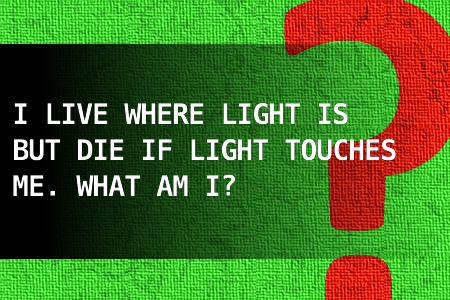
I live where light is but die ...
[2191] I live where light is but die ... - I live where light is but die if light touches me. What am I? - #brainteasers #riddles - Correct Answers: 95 - The first user who solved this task is Sean Snow
BRAIN TEASERS
enter your answer and press button OK

I live where light is but die ...

I live where light is but die if light touches me. What am I?
Correct answers: 95
The first user who solved this task is Sean Snow.
#brainteasers #riddles
Register with your Google Account and start collecting points.
Check your ranking on list.

Reaching the end of a job inte...

Reaching the end of a job interview, the human resources person asked a young engineer fresh out of MIT, "And what starting salary were you looking for?" The engineer said, "In the neighborhood of $125,000 a year, depending on the benefits package." The interviewer said, "Well, what would you say to a package of 5-weeks vacation, 14 paid holidays, full medical and dental, company matching retirement fund to 50% of salary, and a company car leased every 2 years - say, a red Corvette?"
The engineer sat up straight and said, "Wow! Are you kidding?" And the interviewer replied, "Yeah, but you started it."
Jokes of the day - Daily updated jokes. New jokes every day.
Follow Brain Teasers on social networks

Brain Teasers

puzzles, riddles, mathematical problems, mastermind, cinemania...

Sir John Bennet Lawes

Born 28 Dec 1814; died 31 Aug 1900 at age 85.(1st Baronet) English agronomist who initiated the artificial fertiliser industry and founded the world's first agricultural research station. While a young man, he studied how manures improved growth of potted plants and crops. In 1842, having patented a method to make superphosphate by treating phosphate rock with sulphuric acid, he started the first artificial fertiliser factory. In 1843, Lawes opened the Rothamsted Experimental Station where he began a 57-yr collaboration with chemist Joseph Henry Gilbert. They developed modern scientific agriculture, researching animal nutrition with different fodders, and the effect on crop yields of inorganic and organic fertilisers. Some of their long-term field experiments continue to this day.«
This site uses cookies to store information on your computer. Some are essential to help the site properly. Others give us insight into how the site is used and help us to optimize the user experience. See our privacy policy.