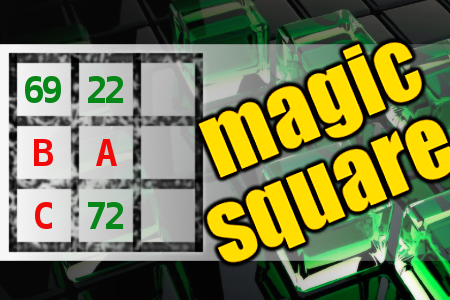
MAGIC SQUARE: Calculate A-B*C
[1783] MAGIC SQUARE: Calculate A-B*C - The aim is to place the some numbers from the list (4, 5, 7, 20, 21, 22, 24, 34, 69, 70, 72) into the empty squares and squares marked with A, B an C. Sum of each row and column should be equal. All the numbers of the magic square must be different. Find values for A, B, and C. Solution is A-B*C. - #brainteasers #math #magicsquare - Correct Answers: 44 - The first user who solved this task is Sanja Šabović
BRAIN TEASERS
enter your answer and press button OK

MAGIC SQUARE: Calculate A-B*C

The aim is to place the some numbers from the list (4, 5, 7, 20, 21, 22, 24, 34, 69, 70, 72) into the empty squares and squares marked with A, B an C. Sum of each row and column should be equal. All the numbers of the magic square must be different. Find values for A, B, and C. Solution is A-B*C.
Correct answers: 44
The first user who solved this task is Sanja Šabović.
#brainteasers #math #magicsquare
Register with your Google Account and start collecting points.
Check your ranking on list.

Never Single

Do you know why potatoes are never single in a bag?
Because they have a lot of buds.

Jokes of the day - Daily updated jokes. New jokes every day.
Follow Brain Teasers on social networks

Brain Teasers

puzzles, riddles, mathematical problems, mastermind, cinemania...

Robert Brown

Born 21 Dec 1773; died 10 Jun 1858 at age 84. Scottish botanist who was an outsatanding authority on plant physiology in his day. He improved the natural classification of plants by establishing and defining new families and genera, but is best known for being the first to notice the natural continuous movement of minute particles in colloidal solution (1828), since known as Brownian movement. Later scientists recognized that this gives direct evidence of molecular motion in liquids, and links to the kinetic theory of gases. Brown distinquished (1826) between what became known as the conifers (gymnosperms) and the flowering plants (angiosperms). In living cells he recognized a structure for which he coined the name nucleus (Latin: "little nut").«
This site uses cookies to store information on your computer. Some are essential to help the site properly. Others give us insight into how the site is used and help us to optimize the user experience. See our privacy policy.