
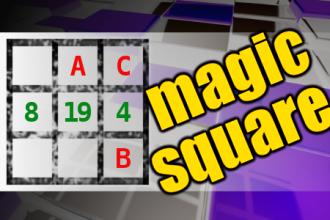
MAGIC SQUARE: Calculate A-B+C
[1952] MAGIC SQUARE: Calculate A-B+C - The aim is to place the some numbers from the list (3, 4, 6, 7, 8, 9, 10, 16, 18, 19, 21, 84, 99) into the empty squares and squares marked with A, B an C. Sum of each row and column should be equal. All the numbers of the magic square must be different. Find values for A, B, and C. Solution is A-B+C. - #brainteasers #math #magicsquare - Correct Answers: 45 - The first user who solved this task is Sanja Šabović
BRAIN TEASERS
enter your answer and press button OK

MAGIC SQUARE: Calculate A-B+C

The aim is to place the some numbers from the list (3, 4, 6, 7, 8, 9, 10, 16, 18, 19, 21, 84, 99) into the empty squares and squares marked with A, B an C. Sum of each row and column should be equal. All the numbers of the magic square must be different. Find values for A, B, and C. Solution is A-B+C.
Correct answers: 45
The first user who solved this task is Sanja Šabović.
#brainteasers #math #magicsquare
Register with your Google Account and start collecting points.
Check your ranking on list.

Q: How did the blonde fisherma...

Q: How did the blonde fisherman die?
A: He was run over by the Zamboni.
Jokes of the day - Daily updated jokes. New jokes every day.
Follow Brain Teasers on social networks

Brain Teasers

puzzles, riddles, mathematical problems, mastermind, cinemania...

Donald R. Griffin

Born 3 Aug 1915; died 7 Nov 2003 at age 88. Donald Redfield Griffin was an American biophysicist, known for his research in animal navigation, animal behaviour, and sensory biophysics. With Robert Galambos, he studied bat echolocation (1938), a term he coined (1944) for how the bat's ears replace eyes in flight guidance. Using specialized high-frequency sound equipment by G.W. Pierce, they found that bats in flight produced ultrasonic sounds used to avoid obstacles. In WW II, he used physiological principles to design such military equipment as cold-weather clothing and headphones. Griffin also worked extensively on bird navigation. In the late 1940s, he flew in a Piper Cub to observe the flight paths of gannets and gulls. In his career, he pioneered rigorous techniques to study animals in their natural environment.«
This site uses cookies to store information on your computer. Some are essential to help the site properly. Others give us insight into how the site is used and help us to optimize the user experience. See our privacy policy.