MAGIC SQUARE: Calculate A-B*C
[2103] MAGIC SQUARE: Calculate A-B*C - The aim is to place the some numbers from the list (17, 19, 20, 21, 22, 24, 25, 38, 40, 41) into the empty squares and squares marked with A, B an C. Sum of each row and column should be equal. All the numbers of the magic square must be different. Find values for A, B, and C. Solution is A-B*C. - #brainteasers #math #magicsquare - Correct Answers: 39 - The first user who solved this task is Djordje Timotijevic
BRAIN TEASERS
enter your answer and press button OK

MAGIC SQUARE: Calculate A-B*C

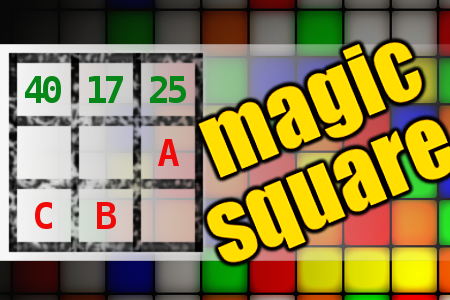
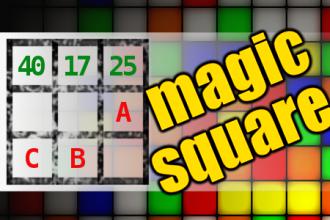
The aim is to place the some numbers from the list (17, 19, 20, 21, 22, 24, 25, 38, 40, 41) into the empty squares and squares marked with A, B an C. Sum of each row and column should be equal. All the numbers of the magic square must be different. Find values for A, B, and C. Solution is A-B*C.
Correct answers: 39
The first user who solved this task is Djordje Timotijevic.
#brainteasers #math #magicsquare
Register with your Google Account and start collecting points.
Check your ranking on list.

What did the digital clock...

Q. What did the digital clock say to the analog clock?
A. Look, No hands!
Jokes of the day - Daily updated jokes. New jokes every day.
Follow Brain Teasers on social networks

Brain Teasers

puzzles, riddles, mathematical problems, mastermind, cinemania...

Gustav Tammann

Died 17 Dec 1938 at age 77 (born 9 Jun 1861).Gustav (Heinrich Johann Apollon) Tammann was a Russian chemist who helped to found the science of metallurgy and pioneered in the study of the internal structure and physical properties of metals and their alloys. In addition, his studies on heterogenous equilibria (i.e., the behaviour of matter as a function of chemical composition, temperature, and pressure) played a major role in systematizing inorganic chemistry and contributed significantly to the development of physical chemistry as a discipline. In 1903, Gustav Tammann established the first Institute of Inorganic Chemistry in Germany, before switching his research interest to the physical chemistry of metals and alloys.
This site uses cookies to store information on your computer. Some are essential to help the site properly. Others give us insight into how the site is used and help us to optimize the user experience. See our privacy policy.