MAGIC SQUARE: Calculate A*B+C
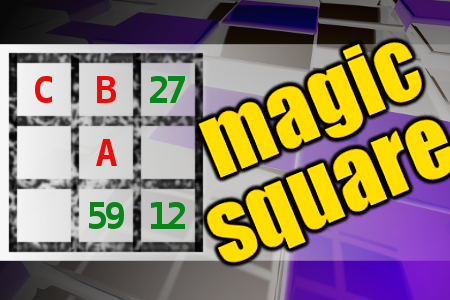
[2306] MAGIC SQUARE: Calculate A*B+C - The aim is to place the some numbers from the list (12, 14, 15, 24, 26, 27, 55, 56, 58, 59, 71, 97) into the empty squares and squares marked with A, B an C. Sum of each row and column should be equal. All the numbers of the magic square must be different. Find values for A, B, and C. Solution is A*B+C. - #brainteasers #math #magicsquare - Correct Answers: 32 - The first user who solved this task is Roxana zavari
BRAIN TEASERS
enter your answer and press button OK

MAGIC SQUARE: Calculate A*B+C

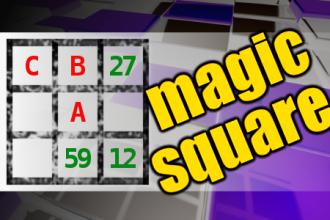
The aim is to place the some numbers from the list (12, 14, 15, 24, 26, 27, 55, 56, 58, 59, 71, 97) into the empty squares and squares marked with A, B an C. Sum of each row and column should be equal. All the numbers of the magic square must be different. Find values for A, B, and C. Solution is A*B+C.
Correct answers: 32
The first user who solved this task is Roxana zavari.
#brainteasers #math #magicsquare
Register with your Google Account and start collecting points.
Check your ranking on list.

Two women were sitting on the...

Two women were sitting on the front porch of the farm house when they saw a rooster chasing a hen. The hen ran straight into the road and was killed by a passing car.
One of the women sighed, "How beautiful. She'd rather die."
Jokes of the day - Daily updated jokes. New jokes every day.
Follow Brain Teasers on social networks

Brain Teasers

puzzles, riddles, mathematical problems, mastermind, cinemania...

Giulio Natta

Born 26 Feb 1903; died 2 May 1979 at age 76.Italian chemist who contributed to the development of high polymers useful in the manufacture of films, plastics, fibres, and synthetic rubber. Along with Karl Ziegler of Germany, he was honoured in 1963 with the Nobel Prize for Chemistry for the development of Ziegler-Natta catalysts. Natta found that certain types of Ziegler catalysts lead to macromolecules with a spatially uniform structure, called isotactic chains. Whereas ordinary hydrocarbon chains are zigzaged, isotactic chains form helices with the side groups pointing outwards. Such polymers give rise to novel synthetic products. Examples are light but strong fabrics, and ropes which float on the water.
This site uses cookies to store information on your computer. Some are essential to help the site properly. Others give us insight into how the site is used and help us to optimize the user experience. See our privacy policy.