MAGIC SQUARE: Calculate A+B+C
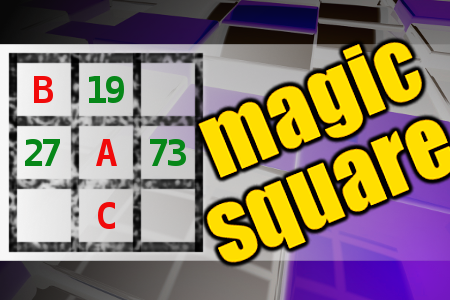
[2739] MAGIC SQUARE: Calculate A+B+C - The aim is to place the some numbers from the list (12, 15, 16, 18, 19, 24, 27, 50, 53, 72, 73, 81) into the empty squares and squares marked with A, B an C. Sum of each row and column should be equal. All the numbers of the magic square must be different. Find values for A, B, and C. Solution is A+B+C. - #brainteasers #math #magicsquare - Correct Answers: 40 - The first user who solved this task is Miloš Mitić
BRAIN TEASERS
enter your answer and press button OK

MAGIC SQUARE: Calculate A+B+C

The aim is to place the some numbers from the list (12, 15, 16, 18, 19, 24, 27, 50, 53, 72, 73, 81) into the empty squares and squares marked with A, B an C. Sum of each row and column should be equal. All the numbers of the magic square must be different. Find values for A, B, and C. Solution is A+B+C.
Correct answers: 40
The first user who solved this task is Miloš Mitić.
#brainteasers #math #magicsquare
Register with your Google Account and start collecting points.
Check your ranking on list.

Two guys are out hiking. All o...

Two guys are out hiking. All of a sudden, a bear starts chasing them.
They climb a tree, but the bear starts climbing up the tree after them. The first guy gets his sneakers out of his knapsack and starts putting them on.
The second guy says, "What are you doing?"
He says, "I figure when the bear gets close to us, we'll jump down and make a run for it."
The second guy says, "Are you crazy? You can't outrun a bear."
The first guy says, "I don't have to outrun the bear. I only have to outrun you."
Jokes of the day - Daily updated jokes. New jokes every day.
Follow Brain Teasers on social networks

Brain Teasers

puzzles, riddles, mathematical problems, mastermind, cinemania...

Henri Becquerel

Born 15 Dec 1852; died 25 Aug 1908 at age 55. Antoine-Henri Becquerel was a French physicist who discovered radioactivity in fluorescent salts of uranium. “In recognition of the extraordinary services he has rendered by his discovery of spontaneous radioactivity,” he shared the 1903 Nobel Prize for Physics (with Pierre and Marie Curie). His early researches were in optics. In 1896, in a drawer, he had stored for a few days a photographic plate in black paper, and some uranium mineral crystals left on it. Later, he found developed the plate was fogged. The crystals, long out of sunlight, could not fluoresce, yet he accidentally discovered the salt was a source of a penetrating radiation: radioactivity. Three years later he showed the rays were charged particles by their deflection in a magnetic field. Initially, the rays emitted by radioactive substances were named after him.«
This site uses cookies to store information on your computer. Some are essential to help the site properly. Others give us insight into how the site is used and help us to optimize the user experience. See our privacy policy.