MAGIC SQUARE: Calculate A-B-C
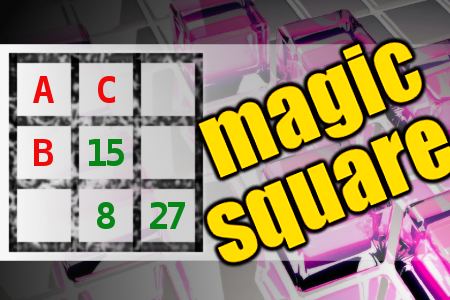
[2902] MAGIC SQUARE: Calculate A-B-C - The aim is to place the some numbers from the list (4, 5, 8, 14, 15, 18, 24, 26, 27, 30) into the empty squares and squares marked with A, B an C. Sum of each row and column should be equal. All the numbers of the magic square must be different. Find values for A, B, and C. Solution is A-B-C. - #brainteasers #math #magicsquare - Correct Answers: 36 - The first user who solved this task is On On Lunarbasil
BRAIN TEASERS
enter your answer and press button OK

MAGIC SQUARE: Calculate A-B-C

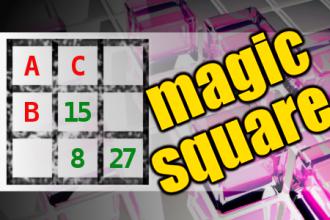
The aim is to place the some numbers from the list (4, 5, 8, 14, 15, 18, 24, 26, 27, 30) into the empty squares and squares marked with A, B an C. Sum of each row and column should be equal. All the numbers of the magic square must be different. Find values for A, B, and C. Solution is A-B-C.
Correct answers: 36
The first user who solved this task is On On Lunarbasil.
#brainteasers #math #magicsquare
Register with your Google Account and start collecting points.
Check your ranking on list.

My wife is better

Jake and his buddy Fred visit a brothel. Jake goes into the room with the prostitute first while Fred waits outside.

When he's done, Jake closes the door behind him and says: "Don't waste your time. My wife's better."

But Fred goes in anyway. When he emerges 15 minutes later, he shakes his head in disappointment and says:

"Damn, Jake, you were right. Your wife is better."

Jokes of the day - Daily updated jokes. New jokes every day.
Follow Brain Teasers on social networks

Brain Teasers

puzzles, riddles, mathematical problems, mastermind, cinemania...

Edward Troughton

Died 12 Jun 1835 (born Oct 1753).English scientist and instrument maker. Troughton soon established himself as the leading maker of instruments in England. Not only did he make great improvements in the design of existing instruments, but he also invented many new instruments. He began his instrument making career with instruments to aid navigation, for example, he designed the 'pillar' sextant, patented in 1788, the dip sector, the marine barometer and the reflecting circle built in 1796. Other instruments which he designed were for use in surveying. He designed the pyrometer, the mountain barometer and the large surveying theodolites. His famous instruments were astronomical ones. He made the Groombridge Transit Circle in 1805 and a six foot Mural Transit Circle in 1810 which was erected at the Observatory in Greenwich in 1812.
This site uses cookies to store information on your computer. Some are essential to help the site properly. Others give us insight into how the site is used and help us to optimize the user experience. See our privacy policy.