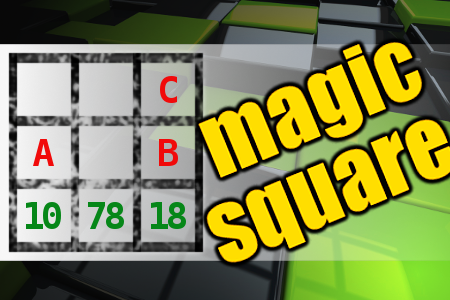
MAGIC SQUARE: Calculate A*B-C
[3281] MAGIC SQUARE: Calculate A*B-C - The aim is to place the some numbers from the list (4, 10, 12, 16, 17, 18, 23, 57, 71, 73, 78, 93) into the empty squares and squares marked with A, B an C. Sum of each row and column should be equal. All the numbers of the magic square must be different. Find values for A, B, and C. Solution is A*B-C. - #brainteasers #math #magicsquare - Correct Answers: 40 - The first user who solved this task is On On Lunarbasil
BRAIN TEASERS
enter your answer and press button OK

MAGIC SQUARE: Calculate A*B-C

The aim is to place the some numbers from the list (4, 10, 12, 16, 17, 18, 23, 57, 71, 73, 78, 93) into the empty squares and squares marked with A, B an C. Sum of each row and column should be equal. All the numbers of the magic square must be different. Find values for A, B, and C. Solution is A*B-C.
Correct answers: 40
The first user who solved this task is On On Lunarbasil.
#brainteasers #math #magicsquare
Register with your Google Account and start collecting points.
Check your ranking on list.

Character Recognition and the Secret Service

Donald Trump is walking out of the White House and heading toward his limo when an assassin steps forward and aims a gun.
A secret service agent, new on the job, shouts, “Mickey Mouse!”
This startles the would-be assassin, and he is captured.
Later, the secret service agent’s supervisor takes him aside and asks,
“What in the hell made you shout Mickey Mouse?”
(Wait for it....)

Blushing, the agent replies, “I got nervous. I meant to shout, “Donald duck!”

Jokes of the day - Daily updated jokes. New jokes every day.
Follow Brain Teasers on social networks

Brain Teasers

puzzles, riddles, mathematical problems, mastermind, cinemania...

Ernst Heinrich Weber

Born 24 Jun 1795; died 26 Jan 1878 at age 82.German anatomist and physiologist whose fundamental studies of the sense of touch introduced a concept, important to psychology and sensory physiology, that of the "just-noticeable difference", the smallest difference perceivable between two similar stimuli. With his brother Eduard Friedrich Weber (1806-71) he discovered the inhibitory power of the vagus nerve (1845). With another brother, W. E. Weber, he made studies of acoustics and wave motion. He formuled Weber's law: that the increase in stimulus necessary to produce an increase in sensation is not fixed but depends on the strength of the preceding stimulus.
This site uses cookies to store information on your computer. Some are essential to help the site properly. Others give us insight into how the site is used and help us to optimize the user experience. See our privacy policy.