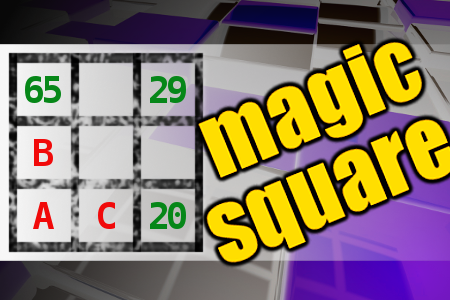
MAGIC SQUARE: Calculate A-B-C
[6277] MAGIC SQUARE: Calculate A-B-C - The aim is to place the some numbers from the list (19, 20, 21, 27, 28, 29, 42, 64, 65, 66, 76) into the empty squares and squares marked with A, B an C. Sum of each row and column should be equal. All the numbers of the magic square must be different. Find values for A, B, and C. Solution is A-B-C. - #brainteasers #math #magicsquare - Correct Answers: 11 - The first user who solved this task is Nílton Corrêa de Sousa
BRAIN TEASERS
enter your answer and press button OK

MAGIC SQUARE: Calculate A-B-C

The aim is to place the some numbers from the list (19, 20, 21, 27, 28, 29, 42, 64, 65, 66, 76) into the empty squares and squares marked with A, B an C. Sum of each row and column should be equal. All the numbers of the magic square must be different. Find values for A, B, and C. Solution is A-B-C.
Correct answers: 11
The first user who solved this task is Nílton Corrêa de Sousa.
#brainteasers #math #magicsquare

Register with your Google Account and start collecting points.
Check your ranking on list.

A woman can always tell if

A woman can always tell if a man loves her by how much time he’s willing to invest.  Money spent is meaningless, but time spent is priceless.
Jokes of the day - Daily updated jokes. New jokes every day.
Follow Brain Teasers on social networks

Brain Teasers

puzzles, riddles, mathematical problems, mastermind, cinemania...

Watermark patent

In 1819, a triple paper was patented in Britain by Sir William Congreve that could incorporate a colored watermark, visible when the paper was held up to the light, to make currency harder to counterfeit. His invention was to overlay a very thin couched sheet of white paper on each side of a layer of colored pulp containing a design, which would then be pressed together and dried. He made a proposal to the Commission of the Bank of England on 30 Oct 1818, but his process was not adopted due to resistance from the Portals firm which had manufactured the Bank of England's currency paper since 1725. Congreve is best known for his invention of military rockets, first used militarily, against the French, on 8 Oct 1806.«
This site uses cookies to store information on your computer. Some are essential to help the site properly. Others give us insight into how the site is used and help us to optimize the user experience. See our privacy policy.