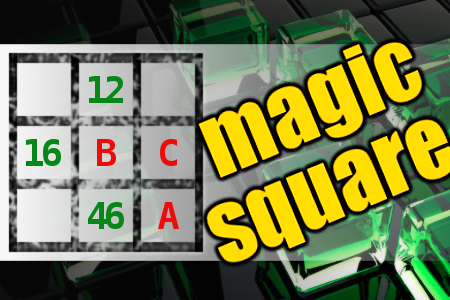
MAGIC SQUARE: Calculate A+B+C
[3443] MAGIC SQUARE: Calculate A+B+C - The aim is to place the some numbers from the list (11, 12, 16, 17, 18, 22, 41, 42, 46, 99) into the empty squares and squares marked with A, B an C. Sum of each row and column should be equal. All the numbers of the magic square must be different. Find values for A, B, and C. Solution is A+B+C. - #brainteasers #math #magicsquare - Correct Answers: 39 - The first user who solved this task is Snezana Milanovic
BRAIN TEASERS
enter your answer and press button OK

MAGIC SQUARE: Calculate A+B+C

The aim is to place the some numbers from the list (11, 12, 16, 17, 18, 22, 41, 42, 46, 99) into the empty squares and squares marked with A, B an C. Sum of each row and column should be equal. All the numbers of the magic square must be different. Find values for A, B, and C. Solution is A+B+C.
Correct answers: 39
The first user who solved this task is Snezana Milanovic.
#brainteasers #math #magicsquare
Register with your Google Account and start collecting points.
Check your ranking on list.

Learn how to lead your heart

Learn how to lead your heart; start recognizing when something isn’t good for you and be strong enough to let it go. A person can only waste the time you give them an opportunity to waste. Stop trying to open doors for people who constantly shut you out. Make sure the interest is shown in the effort, the talk is supported by the actions, and the trust is earned through the consistency.
Jokes of the day - Daily updated jokes. New jokes every day.
Follow Brain Teasers on social networks

Brain Teasers

puzzles, riddles, mathematical problems, mastermind, cinemania...

Vulcanized rubber

In 1844, Charles Goodyear received another patent (U.S. No. 3,633) for "An Improvement in India-Rubber Fabrics." This way of processing india-rubber added white lead to the sulphur and heating method he patented 24 Feb 1839. He had spent several years, since going bankrupt in hardware, trying to improve natural rubber, which became sticky in summer heat and brittle in the winter. He had experimented to coat it with a powder to make it less sticky when he accidentally dropped a mixture of natural rubber and powdered sulphur on a hot stove in Woburn, Massachusetts. The heat completed the process. Despite the value of his inventions, he died in poverty in 1860. (His earliest patent, 17 Jun 1837 used metallic solutions.)
This site uses cookies to store information on your computer. Some are essential to help the site properly. Others give us insight into how the site is used and help us to optimize the user experience. See our privacy policy.