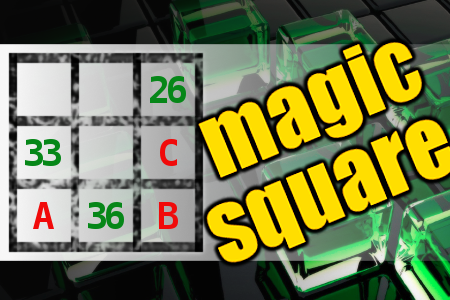
MAGIC SQUARE: Calculate A*B*C
[3571] MAGIC SQUARE: Calculate A*B*C - The aim is to place the some numbers from the list (18, 20, 25, 26, 27, 28, 30, 33, 36) into the empty squares and squares marked with A, B an C. Sum of each row and column should be equal. All the numbers of the magic square must be different. Find values for A, B, and C. Solution is A*B*C. - #brainteasers #math #magicsquare - Correct Answers: 36 - The first user who solved this task is Maryam Pouya
BRAIN TEASERS
enter your answer and press button OK

MAGIC SQUARE: Calculate A*B*C

The aim is to place the some numbers from the list (18, 20, 25, 26, 27, 28, 30, 33, 36) into the empty squares and squares marked with A, B an C. Sum of each row and column should be equal. All the numbers of the magic square must be different. Find values for A, B, and C. Solution is A*B*C.
Correct answers: 36
The first user who solved this task is Maryam Pouya.
#brainteasers #math #magicsquare
Register with your Google Account and start collecting points.
Check your ranking on list.

Assignment Difficulty

An elementary school teacher decides to pole the class on the difficulty of last night's homework assignment:
How many people were able to complete the assignment without parents help?
About 25% of the class raises their hands. How many people we able to complete the assignment with the help of a parent? About 70% of the class raises their hand. The teacher still notices about 5% of the class did not raise their hands.
She then calls out, "How many people had to help a parent complete your assignment?

Jokes of the day - Daily updated jokes. New jokes every day.
Follow Brain Teasers on social networks

Brain Teasers

puzzles, riddles, mathematical problems, mastermind, cinemania...

Aleksandr Mikhailovich Prokhorov

Died 8 Jan 2002 at age 85 (born 11 Jul 1916).Aleksandr Mikhaylovich Prokhorov is the Soviet physicist who received, (with Nikolay G. Basov, USSR and Charles H. Townes, US), the Nobel Prize for Physics in 1964 "for fundamental work in the field of quantum electronics, which has led to the construction of oscillators and amplifiers based on the maser-laser principle." "Maser" stands for "microwave amplification by stimulated emission of radiation." An amplification can occur only if the stimulated emission is larger than the absorption, requiring that there should be more atoms in a high energy state than in a lower one. This state is called an inverted population. Prokhorov had researched the maser independently but simultaneously with the other prize recipients.
This site uses cookies to store information on your computer. Some are essential to help the site properly. Others give us insight into how the site is used and help us to optimize the user experience. See our privacy policy.