MAGIC SQUARE: Calculate A+B-C
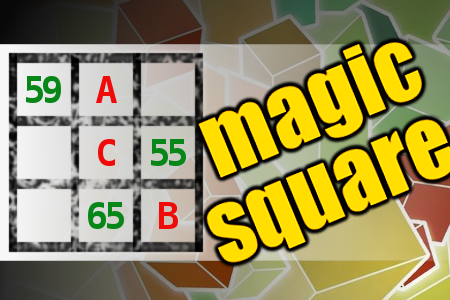
[4513] MAGIC SQUARE: Calculate A+B-C - The aim is to place the some numbers from the list (21, 25, 31, 33, 37, 43, 48, 55, 59, 65, 87) into the empty squares and squares marked with A, B an C. Sum of each row and column should be equal. All the numbers of the magic square must be different. Find values for A, B, and C. Solution is A+B-C. - #brainteasers #math #magicsquare - Correct Answers: 34 - The first user who solved this task is Djordje Timotijevic
BRAIN TEASERS
enter your answer and press button OK

MAGIC SQUARE: Calculate A+B-C

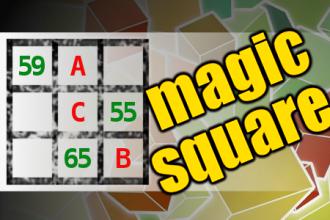
The aim is to place the some numbers from the list (21, 25, 31, 33, 37, 43, 48, 55, 59, 65, 87) into the empty squares and squares marked with A, B an C. Sum of each row and column should be equal. All the numbers of the magic square must be different. Find values for A, B, and C. Solution is A+B-C.
Correct answers: 34
The first user who solved this task is Djordje Timotijevic.
#brainteasers #math #magicsquare
Register with your Google Account and start collecting points.
Check your ranking on list.

World Creativity and Innovation Day Jokes

April 21st is World Creativity and Innovation Day! Find some jokes about it!

Why did the scientist install a knocker on his laboratory door?
Because he wanted to win the "No-bell" prize!

What do you call an innovation in scissors?
Cutting-edge technology

When the first jackhammer was invented... ...it was a groundbreaking innovation!

Jokes of the day - Daily updated jokes. New jokes every day.
Follow Brain Teasers on social networks

Brain Teasers

puzzles, riddles, mathematical problems, mastermind, cinemania...

Michael Owens

Died 27 Dec 1923 at age 64 (born 1 Jan 1859).Michael Joseph Owens was an American inventor and manufacturer who invented the automatic glass bottle making machine that revolutionized the industry. His mechanization of the glass-blowing process eliminated child labor from glass-bottle factories. He took out patents in 1895 on a glass molding machine capable of crude results. In 1903, he formed the Owens Bottle Machine Company. By the next year his continuing improvements led to patents on a machine capable to producing four bottles per second. Owens' machines could be built with from six to twenty arms, each blowing a bottle. He expanded with a factory in England in 1905. He retired from management in 1919 to focus on inventing, and eventually held 45 U.S. patents.«
This site uses cookies to store information on your computer. Some are essential to help the site properly. Others give us insight into how the site is used and help us to optimize the user experience. See our privacy policy.