MAGIC SQUARE: Calculate A*B*C
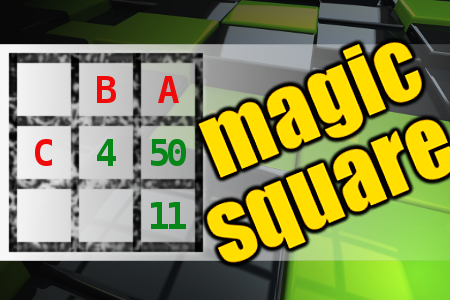
[4661] MAGIC SQUARE: Calculate A*B*C - The aim is to place the some numbers from the list (4, 7, 11, 12, 14, 19, 35, 47, 50, 55) into the empty squares and squares marked with A, B an C. Sum of each row and column should be equal. All the numbers of the magic square must be different. Find values for A, B, and C. Solution is A*B*C. - #brainteasers #math #magicsquare - Correct Answers: 20 - The first user who solved this task is Djordje Timotijevic
BRAIN TEASERS
enter your answer and press button OK

MAGIC SQUARE: Calculate A*B*C

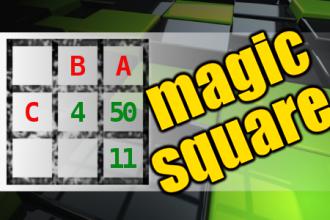
The aim is to place the some numbers from the list (4, 7, 11, 12, 14, 19, 35, 47, 50, 55) into the empty squares and squares marked with A, B an C. Sum of each row and column should be equal. All the numbers of the magic square must be different. Find values for A, B, and C. Solution is A*B*C.
Correct answers: 20
The first user who solved this task is Djordje Timotijevic.
#brainteasers #math #magicsquare
Register with your Google Account and start collecting points.
Check your ranking on list.

An angry wife to her husband o...

An angry wife to her husband on phone: "Where the hell are you?"
Husband: "Darling, you remember that jewelery shop where you saw the diamond necklace and totally fell in love with it, and I didn't have money that time, and I said 'Baby it'll be yours one day'?"
Wife, with a smile and blushing: "Yeah I remember that my love!"
Husband: "I'm in the pub just next to that shop."
Jokes of the day - Daily updated jokes. New jokes every day.
Follow Brain Teasers on social networks

Brain Teasers

puzzles, riddles, mathematical problems, mastermind, cinemania...

Thomas L. Willson

Died 20 Dec 1915 at age 55 (born 14 Mar 1860).Thomas Leopold Willson was a Canadian-American chemist and inventor who discovered a commercial production method for calcium carbide using an electric arc furnace. In 1893, he started a company with John Motley Morehead III in Spray, North Carolina, to try his ideas to obtain aluminium metal from its oxide. On 2 May 1892, he was using an electric arc furnace with coal tar and burnt chalk (lime). An unexpected dark, solid mass was formed. On cooling with water, a gas was given off. This burned with a bright yellow, smoky flame. Analysis showed these were calcium carbide and acetylene. Unlike the earlier method of Wöhler that made calcium carbide in an amorphous form, Willson had a hard, aggregated chrystalline form. He obtained (and defended) patents on his process. He assigned them to the Electro Gas Co. (which became Union Carbide Corp.) His other inventions included gas navigational buoys and electric arc lighting. He established calcium carbide manufacturing in Canada.«
This site uses cookies to store information on your computer. Some are essential to help the site properly. Others give us insight into how the site is used and help us to optimize the user experience. See our privacy policy.