MAGIC SQUARE: Calculate A+B-C
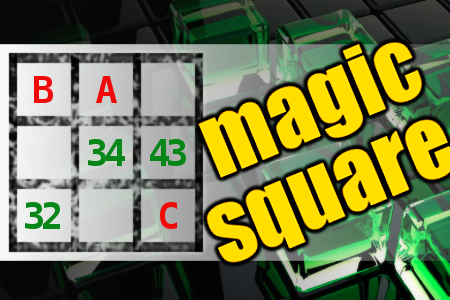
[7112] MAGIC SQUARE: Calculate A+B-C - The aim is to place the some numbers from the list (14, 16, 22, 32, 34, 40, 43, 45, 51, 89) into the empty squares and squares marked with A, B an C. Sum of each row and column should be equal. All the numbers of the magic square must be different. Find values for A, B, and C. Solution is A+B-C. - #brainteasers #math #magicsquare - Correct Answers: 6
BRAIN TEASERS
enter your answer and press button OK

MAGIC SQUARE: Calculate A+B-C

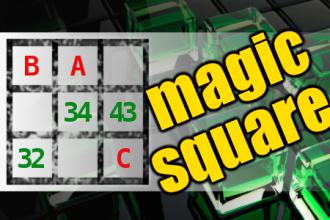
The aim is to place the some numbers from the list (14, 16, 22, 32, 34, 40, 43, 45, 51, 89) into the empty squares and squares marked with A, B an C. Sum of each row and column should be equal. All the numbers of the magic square must be different. Find values for A, B, and C. Solution is A+B-C.
Correct answers: 6
#brainteasers #math #magicsquare
Register with your Google Account and start collecting points.
Check your ranking on list.

A teacher at a polytechnic col...

A teacher at a polytechnic college reminded her pupils of tomorrow's final exam.
"Now listen to me, I won't tolerate any excuses for you not being here tomorrow.
I might consider a nuclear attack or a serious personal injury, illness, or a death in your immediate family, but that's it, no other excuses whatsoever!"
A smart-arsed chappie at the back of the room raised his hand and asked, "What would happen if I came in tomorrow suffering from complete and utter sexual exhaustion?"
The entire class was reduced to laughter and sniggering.
When silence was restored, the teacher smiled knowingly at the student, shook her head and sweetly said, "Well, I suppose you'd have to write the exam with your other hand".
Jokes of the day - Daily updated jokes. New jokes every day.
Follow Brain Teasers on social networks

Brain Teasers

puzzles, riddles, mathematical problems, mastermind, cinemania...

Steam percussion rock drill

In 1849, Joseph J. Couch received the first U.S. patent for a steam-powered percussion rock drill (No. 6,237) as “improved machinery for drilling rocks”. It was driven by steam power and acted without need of gravity supplying any part of the motion. A sliding drill support frame enabled it to be operated in any desirable position or direction. Power was supplied by the piston of a steam cylinder connected to a suitable steam generator. The machine would be held stationary as the rotating drill was thrown against the rock. The drill rod would disengaged at each stroke, and travel with its own momentum, so that upon striking the rock, the shock was not transmitted back to the rest of the machine, preventing it from damage. After each blow, the tool was seized by means of friction-grips to retract and repeat.«
This site uses cookies to store information on your computer. Some are essential to help the site properly. Others give us insight into how the site is used and help us to optimize the user experience. See our privacy policy.