MAGIC SQUARE: Calculate A+B-C
[6033] MAGIC SQUARE: Calculate A+B-C - The aim is to place the some numbers from the list (3, 4, 5, 16, 17, 18, 21, 32, 33, 34) into the empty squares and squares marked with A, B an C. Sum of each row and column should be equal. All the numbers of the magic square must be different. Find values for A, B, and C. Solution is A+B-C. - #brainteasers #math #magicsquare - Correct Answers: 12 - The first user who solved this task is Nílton Corrêa de Sousa
BRAIN TEASERS
enter your answer and press button OK

MAGIC SQUARE: Calculate A+B-C

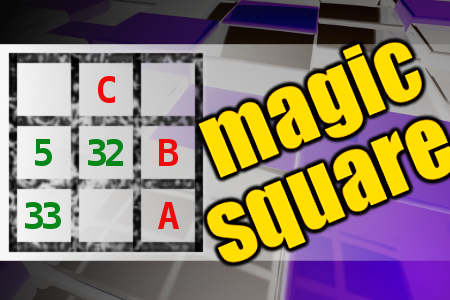
The aim is to place the some numbers from the list (3, 4, 5, 16, 17, 18, 21, 32, 33, 34) into the empty squares and squares marked with A, B an C. Sum of each row and column should be equal. All the numbers of the magic square must be different. Find values for A, B, and C. Solution is A+B-C.
Correct answers: 12
The first user who solved this task is Nílton Corrêa de Sousa.
#brainteasers #math #magicsquare
Register with your Google Account and start collecting points.
Check your ranking on list.

Shack It to Me...in Heaven

A wealthy man died and went to heaven. He was met at the Pearly Gates by Saint Peter who led him down the streets of gold. They passed mansion after mansion until they came to the very end of the street. Saint Peter stopped the rich man in front of a little shack.“This belongs to you,” said Saint Peter.“Why do I get this ugly thing when there are so many mansions I could live in?” the man demanded.“We did the best we could with the money you sent us!” Saint Peter replied.
Jokes of the day - Daily updated jokes. New jokes every day.
Follow Brain Teasers on social networks

Brain Teasers

puzzles, riddles, mathematical problems, mastermind, cinemania...

Alfred Day Hershey

Born 4 Dec 1908; died 22 May 1997 at age 88. American biologist who, along with Max Delbrück and Salvador Luria, won the Nobel Prize for Physiology or Medicine in 1969. The prize was given for research done on bacteriophages (viruses that infect bacteria). This was the famous “blender experiment”(1956). Hershey used an isotope- labeled phage to to infect a bacterial colony and begin to inject their genetic material into the host cells. Then he whirred them in a Waring Blendor to tear the phage particles from the bacterial walls without rupturing the bacteria. Upon examining the bacteria, Hershey found that only phage DNA, but no detectable protein, had been inserted into them. This showed that the DNA was sufficient to transfer to the bacteria all the genetic information needed to produce more phage.
This site uses cookies to store information on your computer. Some are essential to help the site properly. Others give us insight into how the site is used and help us to optimize the user experience. See our privacy policy.