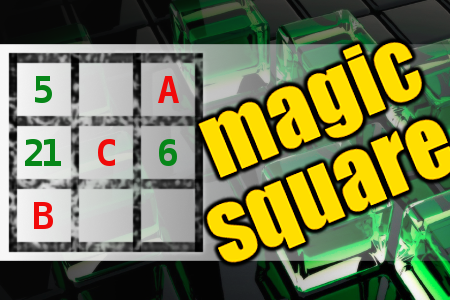
MAGIC SQUARE: Calculate A-B*C
[6152] MAGIC SQUARE: Calculate A-B*C - The aim is to place the some numbers from the list (2, 3, 4, 5, 6, 7, 19, 20, 21, 59, 93) into the empty squares and squares marked with A, B an C. Sum of each row and column should be equal. All the numbers of the magic square must be different. Find values for A, B, and C. Solution is A-B*C. - #brainteasers #math #magicsquare - Correct Answers: 10 - The first user who solved this task is Nasrin 24 T
BRAIN TEASERS
enter your answer and press button OK

MAGIC SQUARE: Calculate A-B*C

The aim is to place the some numbers from the list (2, 3, 4, 5, 6, 7, 19, 20, 21, 59, 93) into the empty squares and squares marked with A, B an C. Sum of each row and column should be equal. All the numbers of the magic square must be different. Find values for A, B, and C. Solution is A-B*C.
Correct answers: 10
The first user who solved this task is Nasrin 24 T.
#brainteasers #math #magicsquare
Register with your Google Account and start collecting points.
Check your ranking on list.

Drummer Problems

A musical director was having a lot of trouble with one drummer. He talked and talked and talked with the drummer, but his performance simply didn't improve.
Finally, before the whole orchestra, he said, "When a musician just can't handle his instrument and doesn't improve when given help, they take away the instrument, and give him two sticks, and make him a drummer."
A stage whisper was heard from the percussion section: "And if he can't handle even that, they take away one of his sticks and make him a conductor."

Jokes of the day - Daily updated jokes. New jokes every day.
Follow Brain Teasers on social networks

Brain Teasers

puzzles, riddles, mathematical problems, mastermind, cinemania...

Bonaventura Cavalieri

Died 30 Nov 1647 (born 1598). Italian mathematician who made developments in geometry that were precursors to integral calculus. Cavalieri's theory of indivisibles, presented in his Geometria indivisibilis continuorum nova (1635) was a development of Archimedes' method of exhaustion incorporating Johannes Kepler's theory of infinitesimally small geometric quantities. The area and volume of various geometric figures can easily be found with this method. He was largely responsible for introducing logarithms as a computational tool in Italy through his book Directorium Generale Uranometricum, including logarithms of trigonometric functions for astronomers. He also wrote on optics and astronomy. Galileo thought highly of his writing, and corresponded with him.
This site uses cookies to store information on your computer. Some are essential to help the site properly. Others give us insight into how the site is used and help us to optimize the user experience. See our privacy policy.