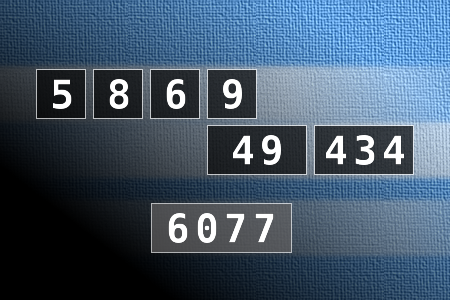
Calculate the number 6077
[6278] Calculate the number 6077 - NUMBERMANIA: Calculate the number 6077 using numbers [5, 8, 6, 9, 49, 434] and basic arithmetic operations (+, -, *, /). Each of the numbers can be used only once. - #brainteasers #math #numbermania - Correct Answers: 11 - The first user who solved this task is Fazil Hashim
BRAIN TEASERS
enter your answer and press button OK

Calculate the number 6077

NUMBERMANIA: Calculate the number 6077 using numbers [5, 8, 6, 9, 49, 434] and basic arithmetic operations (+, -, *, /). Each of the numbers can be used only once.
Correct answers: 11
The first user who solved this task is Fazil Hashim.
#brainteasers #math #numbermania
Register with your Google Account and start collecting points.
Check your ranking on list.

How Many Deists?

Imam Mahdi Funny: Hey, Mahahaharaj.
Swami Mahahaharaj: Yes?
Imam Mahdi Funny: How many deists does it take to change a light bulb?
Swami Mahahaharaj: Hmm...I'm not sure. How many deists does it take to change a light bulb?
Swami Mahahaharaj: None. If the light bulb no longer interferes with the world, why bother interfering with the light bulb?
Jokes of the day - Daily updated jokes. New jokes every day.
Follow Brain Teasers on social networks

Brain Teasers

puzzles, riddles, mathematical problems, mastermind, cinemania...

Auguste Bravais

Born 23 Aug 1811; died 30 Mar 1863 at age 51.French physicist and mineralogist, best remembered for his work on the lattice theory of crystals. Bravais lattices are named for him. In 1850, he showed that crystals could be divided into 14 unit cells for which: (a) the unit cell is the simplest repeating unit in the crystal; (b) opposite faces of a unit cell are parallel; and (c) the edge of the unit cell connects equivalent points. These unit cells fall into seven geometrical categories, which differ in their relative edge lengths and internal angles. In 1866, he elaborated the relationships between the ideal lattice and the material crystal. Sixty years later, Bravais' work provided the mathematical and conceptual basis for the determination of crystal structures after Laue's discovery of X-ray diffraction in 1911.
This site uses cookies to store information on your computer. Some are essential to help the site properly. Others give us insight into how the site is used and help us to optimize the user experience. See our privacy policy.