MAGIC SQUARE: Calculate A+B*C
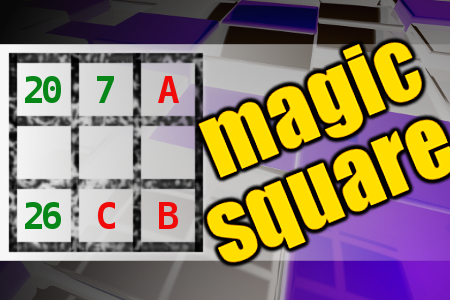
[6411] MAGIC SQUARE: Calculate A+B*C - The aim is to place the some numbers from the list (6, 7, 9, 20, 21, 23, 25, 26, 28, 75) into the empty squares and squares marked with A, B an C. Sum of each row and column should be equal. All the numbers of the magic square must be different. Find values for A, B, and C. Solution is A+B*C. - #brainteasers #math #magicsquare - Correct Answers: 11 - The first user who solved this task is Nílton Corrêa de Sousa
BRAIN TEASERS
enter your answer and press button OK

MAGIC SQUARE: Calculate A+B*C

The aim is to place the some numbers from the list (6, 7, 9, 20, 21, 23, 25, 26, 28, 75) into the empty squares and squares marked with A, B an C. Sum of each row and column should be equal. All the numbers of the magic square must be different. Find values for A, B, and C. Solution is A+B*C.
Correct answers: 11
The first user who solved this task is Nílton Corrêa de Sousa.
#brainteasers #math #magicsquare
Register with your Google Account and start collecting points.
Check your ranking on list.

The salesman was demonstrating...

The salesman was demonstrating unbreakable combs in the department store. He was impressing the people who stopped by to look by putting the comb through all sorts of torture and stress.
Finally to impress even the skeptics in the crowd, he bent the comb completely in half, and it snapped with a loud crack. Without missing a beat, he bravely held up both halves of the 'unbreakable' comb for everyone to see and said,
"And this, ladies and gentlemen, is what an unbreakable comb looks like on the inside..."
Jokes of the day - Daily updated jokes. New jokes every day.
Follow Brain Teasers on social networks

Brain Teasers

puzzles, riddles, mathematical problems, mastermind, cinemania...

John Charles Fields

Born 14 May 1863; died 9 Aug 1932 at age 69.American mathematician who originated the idea, postumously given his name - for the Fields Medal. It became the most prestigious award for mathematicians, often referred to as the equivalent of a Nobel Prize for mathematicians. As a professor at the University of Toronto, he had worked to bring the International Congress of Mathematicians to Toronto (1924). The Congress was so successful that afterward there was a surplus of about $2,500 which Fields, as chairman of the organizing committee, proposed be used to fund two medals to be awarded at each of future Congresses. This was approved on 24 Feb 1931. He died the following year, leaving $47,000 as additional funding for the medals, which have been awarded since 1936.«
This site uses cookies to store information on your computer. Some are essential to help the site properly. Others give us insight into how the site is used and help us to optimize the user experience. See our privacy policy.