MAGIC SQUARE: Calculate A+B*C
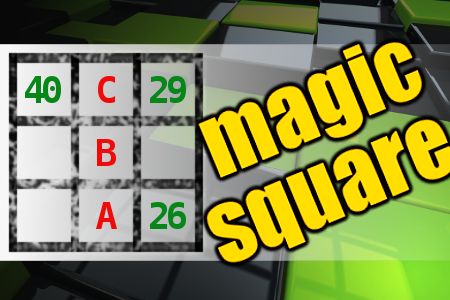
[6631] MAGIC SQUARE: Calculate A+B*C - The aim is to place the some numbers from the list (18, 20, 22, 24, 26, 29, 31, 36, 40, 45, 59, 89, 93) into the empty squares and squares marked with A, B an C. Sum of each row and column should be equal. All the numbers of the magic square must be different. Find values for A, B, and C. Solution is A+B*C. - #brainteasers #math #magicsquare - Correct Answers: 7 - The first user who solved this task is Nasrin 24 T
BRAIN TEASERS
enter your answer and press button OK

MAGIC SQUARE: Calculate A+B*C

The aim is to place the some numbers from the list (18, 20, 22, 24, 26, 29, 31, 36, 40, 45, 59, 89, 93) into the empty squares and squares marked with A, B an C. Sum of each row and column should be equal. All the numbers of the magic square must be different. Find values for A, B, and C. Solution is A+B*C.
Correct answers: 7
The first user who solved this task is Nasrin 24 T.
#brainteasers #math #magicsquare
Register with your Google Account and start collecting points.
Check your ranking on list.

Two elderly ladies had been fr...

Two elderly ladies had been friends for many decades. Over the years they had shared all kinds of activities and adventures. Lately, their activities had been limited to meeting a few times a week to play cards.
One day they were playing cards when one looked at the other and said, "Now don't get mad at me... I know we've been friends for a long time... but I just can't think of your name! I've thought and thought, but I can't remember it. Please tell me what your name is."
Her friend glared at her. For at least three minutes she just stared and glared at her. Finally she said, "How soon do you need to know"?
Jokes of the day - Daily updated jokes. New jokes every day.
Follow Brain Teasers on social networks

Brain Teasers

puzzles, riddles, mathematical problems, mastermind, cinemania...

Calcium carbide process patent

In 1895, Thomas L. Willson received a U.S. patent on the “Calcium-Carbide Process” (No. 541,137) that he had accidentally discovered on 2 May 1892. The patent describes the use of an electric arc furnace to produce calcium carbide from a mixture of finely divided coke and lime. It is produced in molten form, which is then tapped and allowed to cool into a crystalline mass. On the same day, he was granted a patent for his “Product Existing in Form of Crystalline Calcium Carbide” (No. 541,138). When his priority was changed in court by Wöhler, who had discovered a less practical method to make calcium carbide, it was Willson's patent for the crystalline form than won, on appeal. He assigned the patent to the Electro Gas Co., which eventually became Union Carbide Corp.«
This site uses cookies to store information on your computer. Some are essential to help the site properly. Others give us insight into how the site is used and help us to optimize the user experience. See our privacy policy.