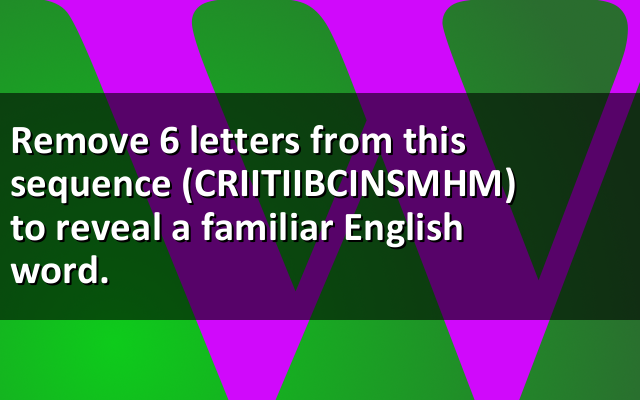
Remove 6 letters from this seq...
[5609] Remove 6 letters from this seq... - Remove 6 letters from this sequence (CRIITIIBCINSMHM) to reveal a familiar English word. - #brainteasers #wordpuzzles - Correct Answers: 43 - The first user who solved this task is Nílton Corrêa De Sousa
BRAIN TEASERS
enter your answer and press button OK

Remove 6 letters from this seq...

Remove 6 letters from this sequence (CRIITIIBCINSMHM) to reveal a familiar English word.
Correct answers: 43
The first user who solved this task is Nílton Corrêa De Sousa.
#brainteasers #wordpuzzles
Register with your Google Account and start collecting points.
Check your ranking on list.

The Shredder

A young executive is working late one evening. As he comes out of his office about 8 PM he sees the Big Boss standing by the shredder in the hallway, a piece of paper in his hand. "Do you know how to work this thing?" the older man asks. "My secretary’s gone home and I don’t know how to run it."
"Yes, sir," says the young executive, who turns on the machine, takes the paper from the other man, and feeds it in.
"Now," says his boss, "I just need the one copy."  

Jokes of the day - Daily updated jokes. New jokes every day.
Follow Brain Teasers on social networks

Brain Teasers

puzzles, riddles, mathematical problems, mastermind, cinemania...

Sir William Osler

Died 29 Dec 1919 at age 70 (born 12 Jul 1849). (Baronet) Canadian physician who revolutionized the medical curriculum in North America, adapting the best of the systems he had observed in England and Germany. He believed that students learn best by doing, teaching medical students at the bedside. He introduced postgraduate training system, instituting a general internship of one year to be followed by a residency of several years. His textbook, The Principles and Practice of Medicine (1892) included the advances of the previous half-century in clinical medical science, and remained the standard text for 40 years. Early in his life, in 1873, he made the most careful description to date of what later were called the "blood-platelets," which was presented to the Royal Society.«
This site uses cookies to store information on your computer. Some are essential to help the site properly. Others give us insight into how the site is used and help us to optimize the user experience. See our privacy policy.