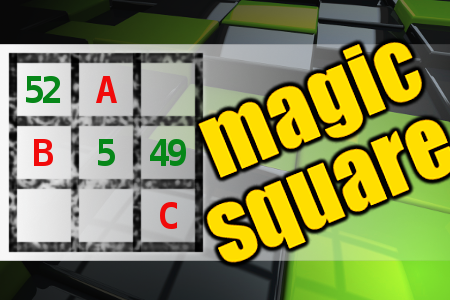
MAGIC SQUARE: Calculate A-B*C
[6668] MAGIC SQUARE: Calculate A-B*C - The aim is to place the some numbers from the list (2, 5, 7, 24, 27, 29, 49, 52, 54) into the empty squares and squares marked with A, B an C. Sum of each row and column should be equal. All the numbers of the magic square must be different. Find values for A, B, and C. Solution is A-B*C. - #brainteasers #math #magicsquare - Correct Answers: 14 - The first user who solved this task is Nasrin 24 T
BRAIN TEASERS
enter your answer and press button OK

MAGIC SQUARE: Calculate A-B*C

The aim is to place the some numbers from the list (2, 5, 7, 24, 27, 29, 49, 52, 54) into the empty squares and squares marked with A, B an C. Sum of each row and column should be equal. All the numbers of the magic square must be different. Find values for A, B, and C. Solution is A-B*C.
Correct answers: 14
The first user who solved this task is Nasrin 24 T.
#brainteasers #math #magicsquare
Register with your Google Account and start collecting points.
Check your ranking on list.

Anxious Cab Driver

A taxi passenger tapped the driver on the shoulder to ask him a question. The driver screamed, lost control of the car, nearly hit a bus, went up on the footpath, and stopped centimeters from a shop window.
For a second everything went quiet in the cab, then the driver said, "Look mate, don't ever do that again. You scared the daylights out of me!" The passenger apologized and said, "I didn't realize that a little tap would scare you so much.

"The driver replied, "Sorry, it's not really your fault. Today is my first day as a cab driver. I've been driving a funeral van for the last 25 years."

Jokes of the day - Daily updated jokes. New jokes every day.
Follow Brain Teasers on social networks

Brain Teasers

puzzles, riddles, mathematical problems, mastermind, cinemania...

Edward Walter Maunder

Born 12 Apr 1851; died 21 Mar 1928 at age 76.English astronomer who was the first to take the British Civil Service Commission examination for the post of photographic and spectroscopic assistant at the Royal Observatory, Greenwich. For the next forty years that he worked there, he made extensive measurements of sunspots. Checking historical records, he found a period from 1645 to 1715 that had a remarkable lack of reports on sunspots. Although he might have questioned the accuracy of the reporting, he instead attributed the shortage of report to an actual dearth of sunspots during that period. Although his suggestion was not generally accepted at first, accumulating research has since indicated there are indeed decades-long times when the sun has notably few sunspots. These periods are now known as Maunder minima.«
This site uses cookies to store information on your computer. Some are essential to help the site properly. Others give us insight into how the site is used and help us to optimize the user experience. See our privacy policy.