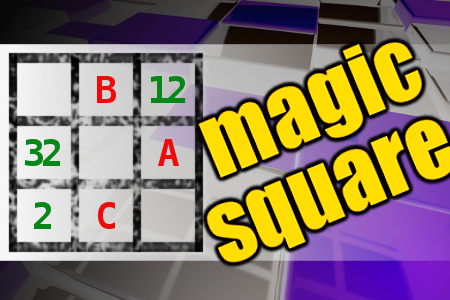
MAGIC SQUARE: Calculate A-B-C
[6798] MAGIC SQUARE: Calculate A-B-C - The aim is to place the some numbers from the list (1, 2, 12, 21, 22, 32, 40, 41, 51, 87) into the empty squares and squares marked with A, B an C. Sum of each row and column should be equal. All the numbers of the magic square must be different. Find values for A, B, and C. Solution is A-B-C. - #brainteasers #math #magicsquare - Correct Answers: 14 - The first user who solved this task is Nasrin 24 T
BRAIN TEASERS
enter your answer and press button OK

MAGIC SQUARE: Calculate A-B-C

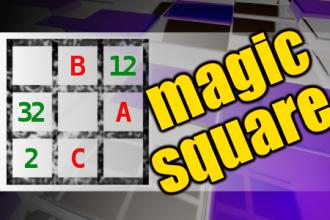
The aim is to place the some numbers from the list (1, 2, 12, 21, 22, 32, 40, 41, 51, 87) into the empty squares and squares marked with A, B an C. Sum of each row and column should be equal. All the numbers of the magic square must be different. Find values for A, B, and C. Solution is A-B-C.
Correct answers: 14
The first user who solved this task is Nasrin 24 T.
#brainteasers #math #magicsquare
Register with your Google Account and start collecting points.
Check your ranking on list.

Two short jokes to get ready for Friday

My mate set me up on a blind date.
He said, "She's a lovely girl, but there's something you should know. She's expecting a baby."
I felt like a right idiot waiting in the pub wearing nothing but a nappy!

My fat wife and I were enjoying a swim in the hotel pool, when a little boy of about five got into trouble and appeared to be drowning.
Luckily, my wife was there to save his life...
She got out to inform the lifeguard and the water level dropped enough for him to stand up!

Jokes of the day - Daily updated jokes. New jokes every day.
Follow Brain Teasers on social networks

Brain Teasers

puzzles, riddles, mathematical problems, mastermind, cinemania...

Vaughan F. R. Jones

Born 31 Dec 1952.Vaughan Frederick Randal Jones is a New Zealand mathematician who was awarded the Fields Medal in 1990 for his study of functional analysis and knot theory. In 1984, Jones discovered a relationship between von Neumann algebras and geometric topology. As a result, he found a new polynomial invariant for knots and links in 3-space. It was a complete surprise because his invariant had been missed completely by topologists, in spite of intense activity in closely related areas during the preceding 60 years.
This site uses cookies to store information on your computer. Some are essential to help the site properly. Others give us insight into how the site is used and help us to optimize the user experience. See our privacy policy.