
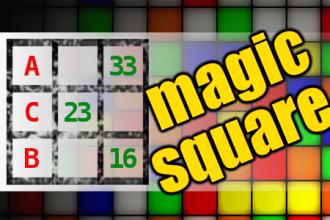
MAGIC SQUARE: Calculate A*B*C
[7021] MAGIC SQUARE: Calculate A*B*C - The aim is to place the some numbers from the list (6, 15, 16, 22, 23, 26, 33, 51, 55, 56, 66) into the empty squares and squares marked with A, B an C. Sum of each row and column should be equal. All the numbers of the magic square must be different. Find values for A, B, and C. Solution is A*B*C. - #brainteasers #math #magicsquare - Correct Answers: 9 - The first user who solved this task is Nasrin 24 T
BRAIN TEASERS
enter your answer and press button OK

MAGIC SQUARE: Calculate A*B*C

The aim is to place the some numbers from the list (6, 15, 16, 22, 23, 26, 33, 51, 55, 56, 66) into the empty squares and squares marked with A, B an C. Sum of each row and column should be equal. All the numbers of the magic square must be different. Find values for A, B, and C. Solution is A*B*C.
Correct answers: 9
The first user who solved this task is Nasrin 24 T.
#brainteasers #math #magicsquare
Register with your Google Account and start collecting points.
Check your ranking on list.

Restaurant

An elderly couple had dinner at another couple's house, and after eating,the wives left the table and went into the kitchen. The two gentlemen were talking, and one said, 'Last night we went out to a new restaurant and it was really great. I would recommend it very highly.'
The other man said, 'What is the name of the restaurant?'
The first man thought and thought and finally said, 'What is the name of that flower you give to someone you love? You know... The one that's red and has thorns.'
'Do you mean a rose?'
'Yes, that's the one,' replied the man. He then turned towards the kitchen and yelled, 'Rose, what's the name of that restaurant we went to last night?  

Jokes of the day - Daily updated jokes. New jokes every day.
Follow Brain Teasers on social networks

Brain Teasers

puzzles, riddles, mathematical problems, mastermind, cinemania...

Hermann Carl Vogel

Born 3 Apr 1842; died 13 Aug 1907 at age 65. German astronomer who discovered spectroscopic binaries (double-star systems that are too close for the individual stars to be discerned by any telescope but, through the analysis of their light, have been found to be two individual stars rapidly revolving around one another). He pioneered the study of light from distant stars, and introduced the use of photography in this field.
This site uses cookies to store information on your computer. Some are essential to help the site properly. Others give us insight into how the site is used and help us to optimize the user experience. See our privacy policy.