
MAGIC SQUARE: Calculate A-B+C
[7049] MAGIC SQUARE: Calculate A-B+C - The aim is to place the some numbers from the list (7, 11, 13, 18, 21, 22, 24, 25, 27, 43) into the empty squares and squares marked with A, B an C. Sum of each row and column should be equal. All the numbers of the magic square must be different. Find values for A, B, and C. Solution is A-B+C. - #brainteasers #math #magicsquare - Correct Answers: 9 - The first user who solved this task is Nasrin 24 T
BRAIN TEASERS
enter your answer and press button OK

MAGIC SQUARE: Calculate A-B+C

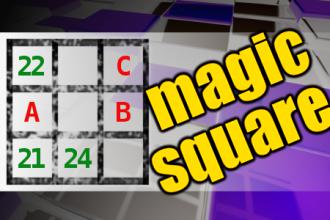
The aim is to place the some numbers from the list (7, 11, 13, 18, 21, 22, 24, 25, 27, 43) into the empty squares and squares marked with A, B an C. Sum of each row and column should be equal. All the numbers of the magic square must be different. Find values for A, B, and C. Solution is A-B+C.
Correct answers: 9
The first user who solved this task is Nasrin 24 T.
#brainteasers #math #magicsquare
Register with your Google Account and start collecting points.
Check your ranking on list.

The salesman was demonstrating...

The salesman was demonstrating unbreakable combs in the department store. He was impressing the people who stopped by to look by putting the comb through all sorts of torture and stress.
Finally to impress even the skeptics in the crowd, he bent the comb completely in half, and it snapped with a loud crack. Without missing a beat, he bravely held up both halves of the 'unbreakable' comb for everyone to see and said,
"And this, ladies and gentlemen, is what an unbreakable comb looks like on the inside..."
Jokes of the day - Daily updated jokes. New jokes every day.
Follow Brain Teasers on social networks

Brain Teasers

puzzles, riddles, mathematical problems, mastermind, cinemania...

Pierre-Marie-Alexis Millardet

Died 15 Dec 1902 at age 64 (born 13 Dec 1838).French botanist who developed the first successful fungicide and also saved the vineyards of France from destruction by the greenish yellow grape phylloxera, an aphidlike plant pest introduced into Europe on vines imported from the United States for grafting (1858-63). The insect swiftly spread extensive destruction. Millardet controlled this plague with resistant American vines as grafting stock, but these brought in the downy mildew fungus. In Oct 1882, he saw chemicals used by farmers for other reasons (a mixture of copper sulfate, lime and water) and after three years of testing, he found it acted as a suitable fungicide for the mildew. Known as the Bordeaux mixture, was the first fungicide to receive large-scale use the world over.
This site uses cookies to store information on your computer. Some are essential to help the site properly. Others give us insight into how the site is used and help us to optimize the user experience. See our privacy policy.