MAGIC SQUARE: Calculate A*B+C
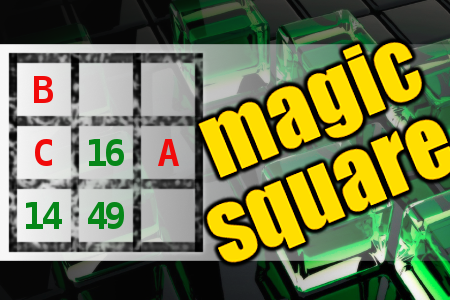
[7760] MAGIC SQUARE: Calculate A*B+C - The aim is to place the some numbers from the list (13, 14, 16, 20, 21, 23, 42, 49, 50, 52, 58, 79) into the empty squares and squares marked with A, B an C. Sum of each row and column should be equal. All the numbers of the magic square must be different. Find values for A, B, and C. Solution is A*B+C. - #brainteasers #math #magicsquare - Correct Answers: 1
BRAIN TEASERS
enter your answer and press button OK

MAGIC SQUARE: Calculate A*B+C

The aim is to place the some numbers from the list (13, 14, 16, 20, 21, 23, 42, 49, 50, 52, 58, 79) into the empty squares and squares marked with A, B an C. Sum of each row and column should be equal. All the numbers of the magic square must be different. Find values for A, B, and C. Solution is A*B+C.
Correct answers: 1
#brainteasers #math #magicsquare
Register with your Google Account and start collecting points.
Check your ranking on list.

Mike Lawrence: Angel's Mouth

My mom wants to manage my comedy career now and I was like, 'Alright mom, why don't you give me some notes?' And one of her notes was, 'You should smile more, you have an angel's mouth.' I feel I should manage my mom in helping her write pickup lines for pedophiles in the wooing phase.
Jokes of the day - Daily updated jokes. New jokes every day.
Follow Brain Teasers on social networks

Brain Teasers

puzzles, riddles, mathematical problems, mastermind, cinemania...

Edison patent

In 1891, Thomas A. Edison was issued a U.S. patent for an innovation for a “Phonograph” (U.S. No. 453,741). The invention consisted of a “means for adjusting a phonograph reproducing-point into exact alignment with the phonogram-record” and also a “means for limiting the movement of the diaphragm which supports the recording and reproducing point when turned to place the reproducer” out of, or into, the operative position. The patent covered only modifications to improve upon the design of his phonograph on which he had previously filed for a patent on 18 Nov 1889 (issued as Patent No. 465,972 on 29 Dec 1891). That related patent for the machine itself was not the first he invented, but a description of a simplified construction. He had various previous patents on the phonograph and improvements.«
This site uses cookies to store information on your computer. Some are essential to help the site properly. Others give us insight into how the site is used and help us to optimize the user experience. See our privacy policy.