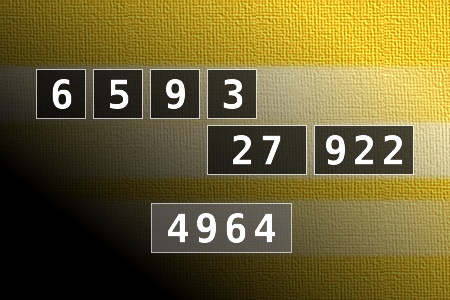
Calculate the number 4964
[7761] Calculate the number 4964 - NUMBERMANIA: Calculate the number 4964 using numbers [6, 5, 9, 3, 27, 922] and basic arithmetic operations (+, -, *, /). Each of the numbers can be used only once. - #brainteasers #math #numbermania - Correct Answers: 1
BRAIN TEASERS
enter your answer and press button OK

Calculate the number 4964

NUMBERMANIA: Calculate the number 4964 using numbers [6, 5, 9, 3, 27, 922] and basic arithmetic operations (+, -, *, /). Each of the numbers can be used only once.
Correct answers: 1
#brainteasers #math #numbermania
Register with your Google Account and start collecting points.
Check your ranking on list.

A man took his wife to the rod...

A man took his wife to the rodeo and one of the first exhibits they stopped at was the breeding bulls.
They went up to the first pen and there was a sign attached that said,
"This bull mated 50 times last year." The wife playfully nudged her husband in the ribs and said, "He mated 50 times last year."
They walked to the second pen which had a sign attached that said, "This bull mated 120 times last year. " The wife gave her husband a healthy jab and said, "That's more than twice a week! You could learn a lot from him."
They walked to the third pen and it had a sign attached that said, in capital letters, "This bull mated 365 times last year." The wife, so excited that her elbow nearly broke her husband's rib, said, "That's once a day.You could REALLY learn something from this one."
The husband looked at her and said, "Go over and ask him if it was with the same cow."
Jokes of the day - Daily updated jokes. New jokes every day.
Follow Brain Teasers on social networks

Brain Teasers

puzzles, riddles, mathematical problems, mastermind, cinemania...

Jean-Robert Argand

Died 13 Aug 1822 at age 54 (born 18 Jul 1768).Swiss accountant and mathematician who was one of the earliest to use complex numbers, which he applied to show that all algebraic equations have roots. His name is associated with the Argand diagram, a geometrical representation of complex numbers as points in a Cartesian plane, with the real portion of the number on the x axis and the imaginary part on the y axis. He self-published this concept in an anonymous monograph (1806). Though talented in mathematics, he remained an amateur; his livelihood was asan accountant and bookkeeper. Although Argand's name became associated with this idea, the geometrical interpretation of complex numbers appeared earliest in work by Caspar Wessel (1787), first presented on 10 Mar 1797 to a the Royal Danish Academy of Sciences and published in 1799.«
This site uses cookies to store information on your computer. Some are essential to help the site properly. Others give us insight into how the site is used and help us to optimize the user experience. See our privacy policy.