MAGIC SQUARE: Calculate A*B*C
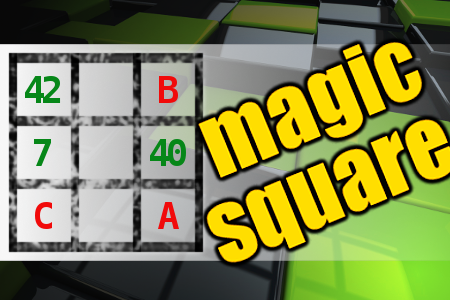
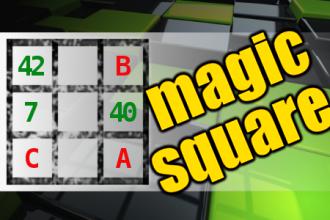
[8031] MAGIC SQUARE: Calculate A*B*C - The aim is to place the some numbers from the list (2, 7, 8, 10, 13, 28, 29, 31, 39, 40, 42) into the empty squares and squares marked with A, B an C. Sum of each row and column should be equal. All the numbers of the magic square must be different. Find values for A, B, and C. Solution is A*B*C. - #brainteasers #math #magicsquare - Correct Answers: 0
BRAIN TEASERS
enter your answer and press button OK

MAGIC SQUARE: Calculate A*B*C

The aim is to place the some numbers from the list (2, 7, 8, 10, 13, 28, 29, 31, 39, 40, 42) into the empty squares and squares marked with A, B an C. Sum of each row and column should be equal. All the numbers of the magic square must be different. Find values for A, B, and C. Solution is A*B*C.
Correct answers: 0
#brainteasers #math #magicsquare
Register with your Google Account and start collecting points.
Check your ranking on list.

Dentist

A guy and a girl meet at a bar. They get along so well that they decide to go to the girl's place.
A few drinks later, the guy takes off his shirt and then washes his hands.
He then takes of his trousers and washes his hands again.
The girl has been watching him and says, "You must be a dentist."
The guy, surprised, says "Yes! How did you figure that out?"
"Easy," she replied, "you keep washing your hands."
One thing led to another and they make love.
After they have done, the girl says, "You must be a good dentist."
The guy, now with a boosted ego says, "Sure, I'm a good dentist, How did you figure that out?"

"Didn't feel a thing!"

Jokes of the day - Daily updated jokes. New jokes every day.
Follow Brain Teasers on social networks

Brain Teasers

puzzles, riddles, mathematical problems, mastermind, cinemania...

Gerhard Herzberg

Born 25 Dec 1904; died 3 Mar 1999 at age 94.German-Canadian physicist who was awarded the 1971 Nobel Prize for Chemistry "for his contributions to the knowledge of electronic structure and geometry of molecules, particularly free radicals." He published his first work in molecular spectroscopy at the end of the 1920's. His measurement of how molecules absorb ultraviolet and infrared energy yield information on energy states in molecules, leading to knowledge of their size, shape and other properties. For example, he showed that radicals can drastically change their shape with increasing energy, such as methylene which is linear in its ground state but bent in higher energy states. He also applied spectroscopy in astronomy, identifying molecules in space, planetary atmospheres and comets.«
This site uses cookies to store information on your computer. Some are essential to help the site properly. Others give us insight into how the site is used and help us to optimize the user experience. See our privacy policy.