MAGIC SQUARE: Calculate A*B-C
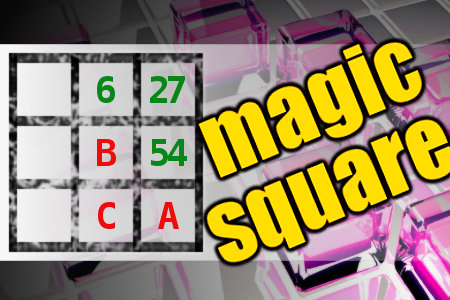
[8080] MAGIC SQUARE: Calculate A*B-C - The aim is to place the some numbers from the list (6, 7, 8, 25, 26, 27, 45, 54, 55, 56) into the empty squares and squares marked with A, B an C. Sum of each row and column should be equal. All the numbers of the magic square must be different. Find values for A, B, and C. Solution is A*B-C. - #brainteasers #math #magicsquare - Correct Answers: 0
BRAIN TEASERS
enter your answer and press button OK

MAGIC SQUARE: Calculate A*B-C

The aim is to place the some numbers from the list (6, 7, 8, 25, 26, 27, 45, 54, 55, 56) into the empty squares and squares marked with A, B an C. Sum of each row and column should be equal. All the numbers of the magic square must be different. Find values for A, B, and C. Solution is A*B-C.
Correct answers: 0
#brainteasers #math #magicsquare
Register with your Google Account and start collecting points.
Check your ranking on list.

Forgive Me Father

About a month ago, a man in Amsterdam felt that he needed to confess, so he went to his priest, "Forgive me Father, for I have sinned. During WWII I hid a refugee in my attic."

"Well," answered the priest, "that's not a sin."'

"But I made him agree to pay me 200 Euros for every week he stayed."

"I admit that wasn't good, but you did it for a good cause."

"Oh, thank you, Father; that eases my mind." He paused for a moment and then said, "I have one more question..."

"What is that, my son?"

"Do I have to tell him the war is over?"

Jokes of the day - Daily updated jokes. New jokes every day.
Follow Brain Teasers on social networks

Brain Teasers

puzzles, riddles, mathematical problems, mastermind, cinemania...

Albert S. Bickmore

Born 1 Mar 1839; died 12 Aug 1914 at age 75.Albert Smith Bickmore was an American naturalist, traveller and museum curator who acquired his love of natural history as a result of growing up in a coastal town. He studied natural history under Professor Agassiz, and shortly also began to care for the department of Mullusca at the Museum of Comparative Zoology at Harvard University. There he conceived the idea of the American Museum of Natural History. By 1865, he set off on a three-year expedition to the East Indies, China, Japan, Russia and Europe gathering specimens to form the basis of the future museum's collection. Upon his return, he devoted himself to indeed establishing the institution, and was able to arrange for its funding. He wrote of his travels in Travels in the East Indian Archipelago (1869). In 1870, he was appointed Professor Natural History at Madison University, Hamilton, New York. The cornerstone of the new building was laid on 2 Jun 1874, by President Grant.«
This site uses cookies to store information on your computer. Some are essential to help the site properly. Others give us insight into how the site is used and help us to optimize the user experience. See our privacy policy.