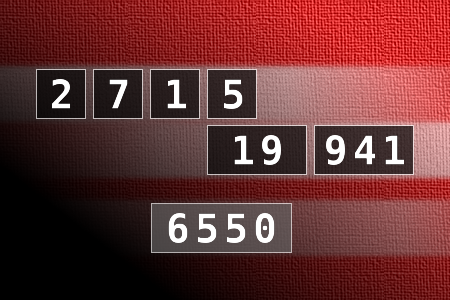
Calculate the number 6550
[8081] Calculate the number 6550 - NUMBERMANIA: Calculate the number 6550 using numbers [2, 7, 1, 5, 19, 941] and basic arithmetic operations (+, -, *, /). Each of the numbers can be used only once. - #brainteasers #math #numbermania - Correct Answers: 0
BRAIN TEASERS
enter your answer and press button OK

Calculate the number 6550

NUMBERMANIA: Calculate the number 6550 using numbers [2, 7, 1, 5, 19, 941] and basic arithmetic operations (+, -, *, /). Each of the numbers can be used only once.
Correct answers: 0
#brainteasers #math #numbermania
Register with your Google Account and start collecting points.
Check your ranking on list.

Proudly showing off his new ap...

Proudly showing off his new apartment to a couple of his friends late one night the drunk led the way to his bedroom where there was a big brass gong.
"What's that big brass gong for?" one of the guests asked. "It's not a gong. It's a talking clock" the drunk replied.
"A talking clock? Seriously?" asked his astonished friend.
"Yup" replied the drunk.
"How's it work?" the second guest asked, squinting at it.
"Watch" the man said. He picked up a hammer, gave it an ear shattering pound and stepped back.
The three stood looking at one another for a moment. Suddenly, someone on the other side of the wall screamed "You friggin' IDIOT!...it's ten past three in the morning!"
Jokes of the day - Daily updated jokes. New jokes every day.
Follow Brain Teasers on social networks

Brain Teasers

puzzles, riddles, mathematical problems, mastermind, cinemania...

Ferdinand Braun

Born 6 Jun 1850; died 20 Apr 1918 at age 67.Karl Ferdinand Braun was a German physicist whosharedthe Nobel Prize for Physics in 1909 with Guglielmo Marconi for the development of wireless telegraphy. He published papers on deviations from Ohm's law and on the calculations of the electromotive force of reversible galvanic elements from thermal sources, and discovered (1874) the electrical rectifier effect. He demonstrated the first cathode-ray oscilloscope (Braun tube) in 1897, after work on high-frequency alternating currents. Cathode-ray tubes had previously been characterized by uncontrolled rays; Braun succeeded in producing a narrow stream of electrons, guided by means of alternating voltage, that could trace patterns on a fluorescent screen.
This site uses cookies to store information on your computer. Some are essential to help the site properly. Others give us insight into how the site is used and help us to optimize the user experience. See our privacy policy.