MAGIC SQUARE: Calculate A-B*C
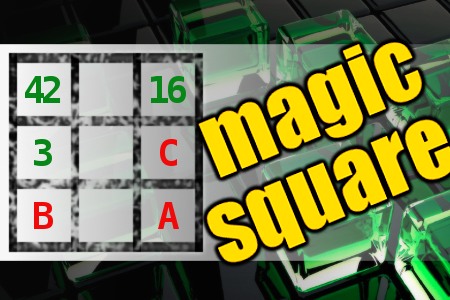
[8428] MAGIC SQUARE: Calculate A-B*C - The aim is to place the some numbers from the list (1, 3, 4, 14, 16, 17, 27, 42, 44, 45, 47) into the empty squares and squares marked with A, B an C. Sum of each row and column should be equal. All the numbers of the magic square must be different. Find values for A, B, and C. Solution is A-B*C. - #brainteasers #math #magicsquare - Correct Answers: 0
BRAIN TEASERS
enter your answer and press button OK

MAGIC SQUARE: Calculate A-B*C

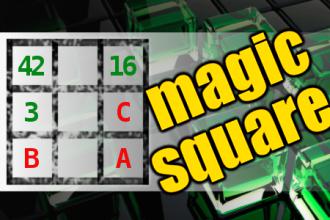
The aim is to place the some numbers from the list (1, 3, 4, 14, 16, 17, 27, 42, 44, 45, 47) into the empty squares and squares marked with A, B an C. Sum of each row and column should be equal. All the numbers of the magic square must be different. Find values for A, B, and C. Solution is A-B*C.
Correct answers: 0
#brainteasers #math #magicsquare
Register with your Google Account and start collecting points.
Check your ranking on list.

What's for supper?

This guy was watching TV as his wife was out cutting the grass during the hot summer. He finally worked up the energy to go out and ask his wife what was for supper.
Well, his missus was quite irritated about him sitting in the air conditioned house all day while she did all the work, so she scolded him. "I can't believe you're asking me about supper right now! Imagine I'm out of town, go inside and figure dinner out yourself."
So he went back in the house and fixed himself a big steak, with potatoes, garlic bread and tall glass of iced tea.
The wife finally walked in about the time he was finishing up and asked him, "You fixed something to eat? So where is mine?"
"Huh? I thought you were out of town."

Jokes of the day - Daily updated jokes. New jokes every day.
Follow Brain Teasers on social networks

Brain Teasers

puzzles, riddles, mathematical problems, mastermind, cinemania...

Mercury vapour lamp

In 1901, the first U.S. patents for a mercury vapour lamp were issued to inventor Peter Cooper Hewitt of New York City (Nos. 682,692-99). These eight patents covered the design of an elongated vacuum tube fitted with a mercury electrode at one end and an iron electrode at the other end. Light was produced when an electric current passed through the mercury vapour. However, it was a garish blue-green colour, lacking any red light. The lamps were subsequently manufactured by the Cooper Hewitt Electric Company in New York City, in Dec 1902. They were an important forerunner of today's fluorescent lights.«
This site uses cookies to store information on your computer. Some are essential to help the site properly. Others give us insight into how the site is used and help us to optimize the user experience. See our privacy policy.