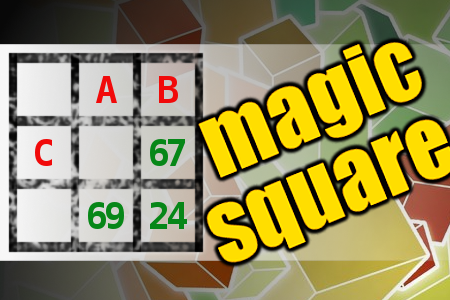
MAGIC SQUARE: Calculate A*B+C
[8511] MAGIC SQUARE: Calculate A*B+C - The aim is to place the some numbers from the list (24, 25, 27, 29, 30, 32, 57, 66, 67, 69, 75) into the empty squares and squares marked with A, B an C. Sum of each row and column should be equal. All the numbers of the magic square must be different. Find values for A, B, and C. Solution is A*B+C. - #brainteasers #math #magicsquare - Correct Answers: 0
BRAIN TEASERS
enter your answer and press button OK

MAGIC SQUARE: Calculate A*B+C

The aim is to place the some numbers from the list (24, 25, 27, 29, 30, 32, 57, 66, 67, 69, 75) into the empty squares and squares marked with A, B an C. Sum of each row and column should be equal. All the numbers of the magic square must be different. Find values for A, B, and C. Solution is A*B+C.
Correct answers: 0
#brainteasers #math #magicsquare
Register with your Google Account and start collecting points.
Check your ranking on list.

A guy who had forgotten the da...

A guy who had forgotten the dates for a number of his friends' and relatives' birthdays and anniversaries, decided to compile a list on the computer and have the dates highlighted on screen when the machine was turned on.
He went to a number of computer stores to find a software program that would do the job but had no luck at the first few. Finally, he found one where the clerk seemed experienced.
"Can you recommend something that will remind me of birthdays and anniversaries?" the guy asked.
"Have you tried a wife?" the clerk responded.
Jokes of the day - Daily updated jokes. New jokes every day.
Follow Brain Teasers on social networks

Brain Teasers

puzzles, riddles, mathematical problems, mastermind, cinemania...

Sir Frederic Bartlett

Born 20 Oct 1886; died 30 Sep 1969 at age 82.Sir Frederic Charles Bartlett was an English psychologist who was Britain's most outstanding cognitive psychologist between the World Wars. He wrote on practical (ergonomic) problems in applied psychology, but is best-known for his pioneering cognitive approach to understanding human memory. In forming one of the earliest models of memory, Bartlett observed that in remembering stories or events there is a tendency for distortions to occur. In his most famous experiment, Bartlett had subjects read a folk tale, tested their recall several times, and studied their changing recountings of the story. People tend to remember what they regard as most important and recall what would have been expected rather than what actually occurred.«
This site uses cookies to store information on your computer. Some are essential to help the site properly. Others give us insight into how the site is used and help us to optimize the user experience. See our privacy policy.