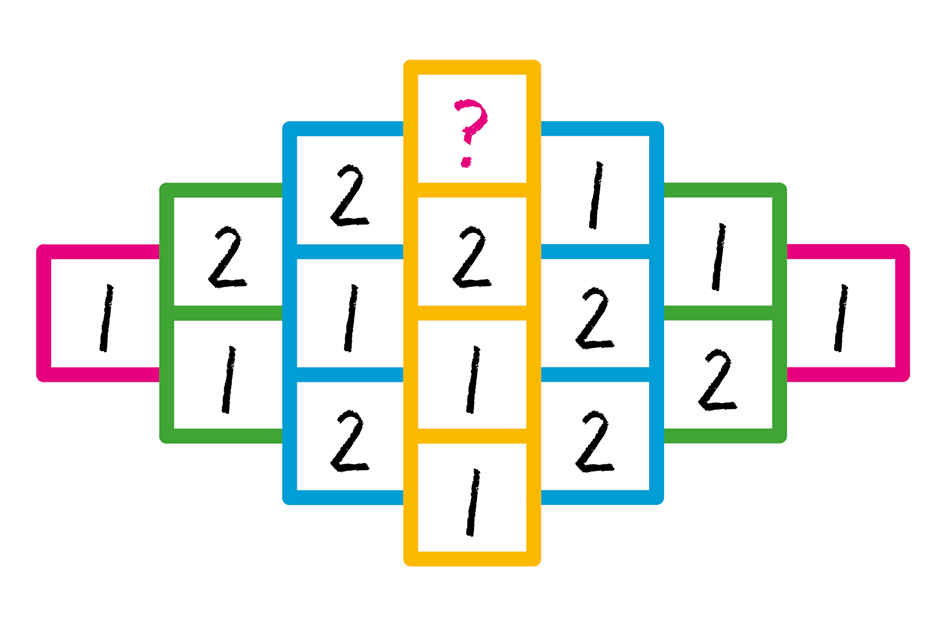
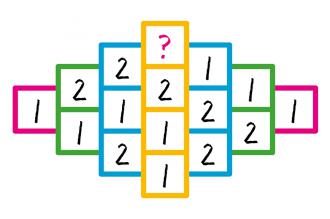
MATH PUZZLE: Can you replace...
[2899] MATH PUZZLE: Can you replace... - MATH PUZZLE: Can you replace the question mark with a number? - #brainteasers #math #riddles - Correct Answers: 330 - The first user who solved this task is Donya Sayah30
BRAIN TEASERS
enter your answer and press button OK

MATH PUZZLE: Can you replace...

MATH PUZZLE: Can you replace the question mark with a number?
Correct answers: 330
The first user who solved this task is Donya Sayah30.
#brainteasers #math #riddles
Register with your Google Account and start collecting points.
Check your ranking on list.

A wealthy merchant of 84 marri...

A wealthy merchant of 84 married a 25 year old fashion model. They had a wonderful honeymoon in Aruba but, unfortunately, the old boy suffered a coronary and was hospitalized.
When his young wife came to see him, the old man said, "Sweetheart, your future has been taken care of regardless of what happens to me. You will have an income of $250,000 a year, my home in Palm Springs, my ranch in Texas, my Mercedes. You'll never need to worry about money."
"Oh, sweetheart, please don't talk that way," his young wife exclaimed. "You've been so good to me already. If you go, I'll be devastated. Oh, there must be something I can do to help you. Please, tell me what I can do?"
"Well," the old man gasped, "you can quit pinching the inlet tube to my oxygen supply for starters."
Jokes of the day - Daily updated jokes. New jokes every day.
Follow Brain Teasers on social networks

Brain Teasers

puzzles, riddles, mathematical problems, mastermind, cinemania...

Henry A. Gleason

Born 2 Jan 1882; died 12 Apr 1975 at age 93. Henry Allan Gleason was an American botanist who was was active with the New York Botanical Garden for 32 years (1918-1950). By age 13, he already was a botany enthusiast. While still in high school, he contributed to The American Naturalist. Early in his career, he travelled to the Philippines, Java and Ceylon to studying tropical vegetation. In 1918, he gave a lecture on his findings, which led to the offer of a permanent position at NYBG, where he developed its South American collection.He was one of the first to consider community ecology. His paper on “The Individualistic Concept of the Plant Association” (1926) concluded that species tended to distribute themselves independently of one another. Eventually, his idea was embraced for the study of vegetation on an ecological and geographical basis. After retirement, he became emeritus head curator.«
This site uses cookies to store information on your computer. Some are essential to help the site properly. Others give us insight into how the site is used and help us to optimize the user experience. See our privacy policy.