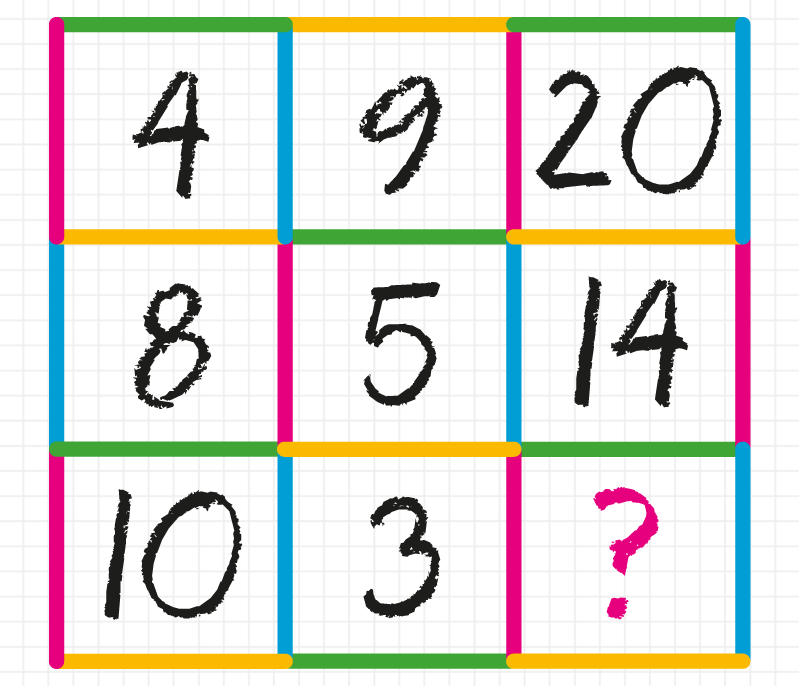
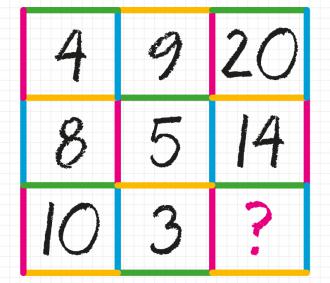
MATH PUZZLE: Can you replace...
[3200] MATH PUZZLE: Can you replace... - MATH PUZZLE: Can you replace the question mark with a number? - #brainteasers #math #riddles - Correct Answers: 583 - The first user who solved this task is Roxana zavari
BRAIN TEASERS
enter your answer and press button OK

MATH PUZZLE: Can you replace...

MATH PUZZLE: Can you replace the question mark with a number?
Correct answers: 583
The first user who solved this task is Roxana zavari.
#brainteasers #math #riddles
Register with your Google Account and start collecting points.
Check your ranking on list.

Helping your father

A clergyman walking down a country lane and sees a young farmer struggling to load hay back onto a cart after it had fallen off.
"You look hot, my son," said the cleric. "why don't you rest a moment, and I'll give you a hand."
"No thanks," said the young man.
"My father wouldn't like it."
"Don't be silly," the minister said.
"Everyone is entitled to a break. Come and have a drink of water."
Again the young man protested that his father would be upset. Losing his patience, the clergyman said, "Your father must be a real slave driver. Tell me where I can find him and I'll give him a piece of my mind!"
"Well," replied the young farmer, "he's under the load of hay."

Jokes of the day - Daily updated jokes. New jokes every day.
Follow Brain Teasers on social networks

Brain Teasers

puzzles, riddles, mathematical problems, mastermind, cinemania...

Walther Hermann Nernst

Born 25 Jun 1864; died 18 Nov 1941 at age 77. German physical chemist who was one of the founders of modern physical chemistry. In 1889, he devised his theory of electric potential and conduction of electrolytic solutions (the Nernst Equation) and introduced the solubility product to explain precipitation reactions. In 1906, Nernst showed that it is possible to determine the equilibrium constant for a chemical reaction from thermal data, and in so doing he formulated what he himself called the third law of thermodynamics. This states that the entropy, (a thermodynamic measure of disorder in a system), approaches zero as the temperature goes towards absolute zero. For this, he was awarded the 1920 Nobel Prize in Chemistry. In 1918, he explained the H2-Cl2 explosion on exposure to light as an atom chain reaction.
This site uses cookies to store information on your computer. Some are essential to help the site properly. Others give us insight into how the site is used and help us to optimize the user experience. See our privacy policy.