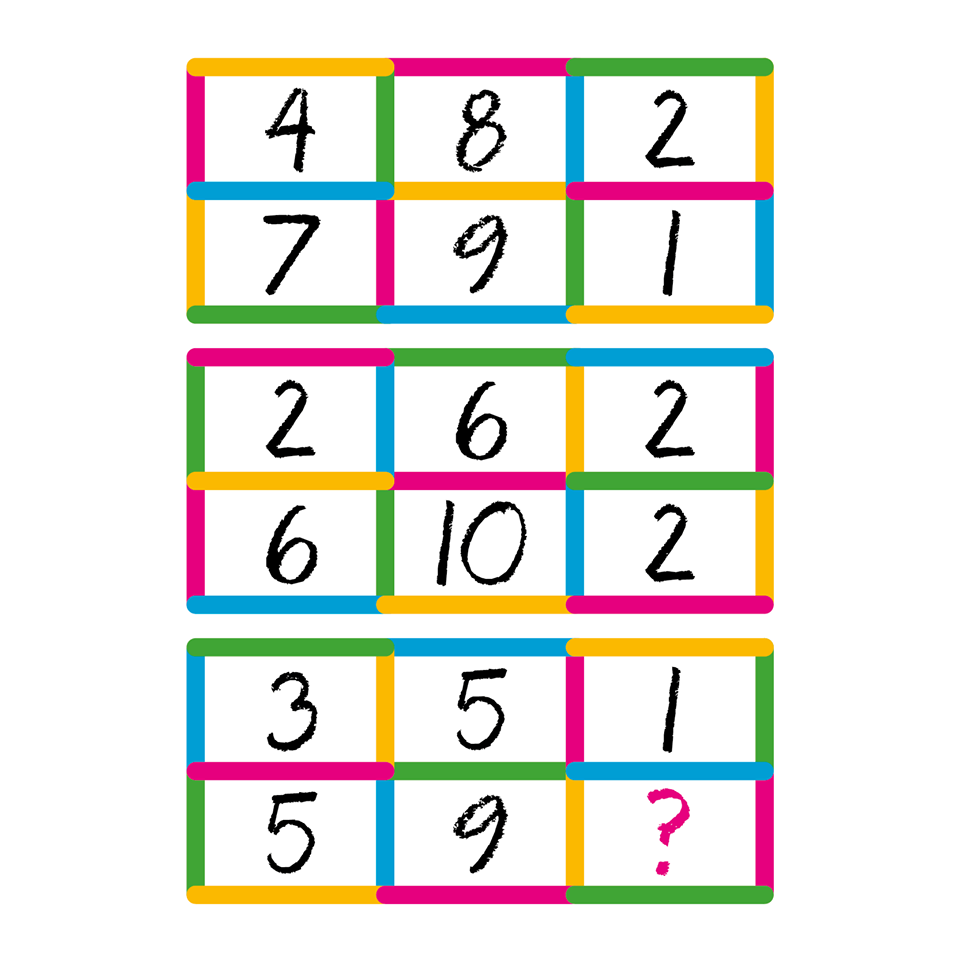
MATH PUZZLE: Can you replace...
[4222] MATH PUZZLE: Can you replace... - MATH PUZZLE: Can you replace the question mark with a number? - #brainteasers #math #riddles - Correct Answers: 286 - The first user who solved this task is Thinh Ddh
BRAIN TEASERS
enter your answer and press button OK

MATH PUZZLE: Can you replace...

MATH PUZZLE: Can you replace the question mark with a number?
Correct answers: 286
The first user who solved this task is Thinh Ddh.
#brainteasers #math #riddles
Register with your Google Account and start collecting points.
Check your ranking on list.

Surprise email

A man checked into a hotel.

There was a computer in his room, so he decided to send a mail to his wife.

However, he accidentally typed the wrong email address, and without realizing he sent the mail to a widow who has just returned from her husband's funeral.

The widow decided to check her mail, expecting condolence messages from relatives and friends.

After reading the first message she fainted.

The son rushed into the room, found his mother on the floor and saw the computer screen which read :

To my loving wife, I know you are surprised to hear from me, they have computers here and we are allowed to send mails to loved ones.

I 've just been checked in.

How are you and the kids, the place is realy nice but am lonely here.

I have made necessary arrangement for your arrival tomorrow. Expecting you darling. I can't wait to see you!

Jokes of the day - Daily updated jokes. New jokes every day.
Follow Brain Teasers on social networks

Brain Teasers

puzzles, riddles, mathematical problems, mastermind, cinemania...

Sir Charles Vernon Boys

Died 30 Mar 1944 at age 89 (born 15 Mar 1855).English physicist and inventor of sensitive instruments. His studies included in mining, metallurgy, chemistry and physics. He was also self-taught in a wide knowledge of geometrical methods. In 1881, he invented the integraph, a machine for drawing the antiderivative of a function. Boys is known particularly for his definitive book (1890) on the physics soap bubbles. He employed the torsion of quartz fibres to measure minute forces, repeating (1895) Henry Cavendish's experiment, to improve the measurement of the Newtonian gravitational constant. He also invented an improved automatic recording calorimeter for testing city coal gas (1905) and high-speed cameras to photograph rapidly moving objects, such as bullets and lightning discharges. He was knighted in 1935. Upon retirement in 1939, he grew and studied garden weeds.«
This site uses cookies to store information on your computer. Some are essential to help the site properly. Others give us insight into how the site is used and help us to optimize the user experience. See our privacy policy.