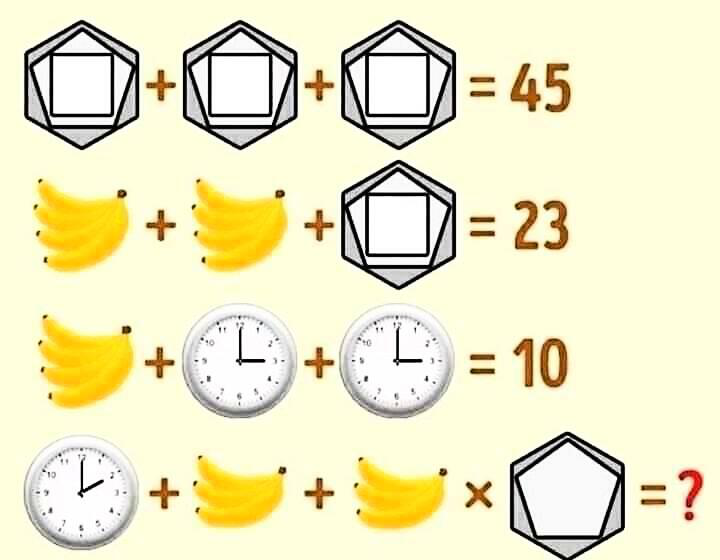
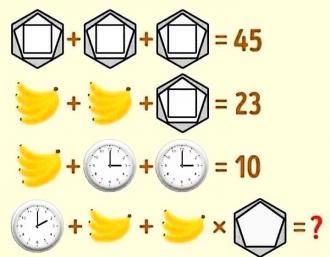
MATH PUZZLE: Can you replace...
MATH PUZZLE: Can you replace the question mark with a number?Correct answers: 460
The first user who solved this task is Nílton Corrêa de Sousa.
#brainteasers #math #riddles

Easy Computer Fix
I received this from a CEO that I worked with a few years back. He doesn't want to admit it but I think this is his true experience.
I was having trouble with my computer so I called Richard, the 11 year old next door whose bedroom looks like Mission Control, and asked him to come over.
Richard clicked a couple of buttons and solved the problem.
As he was walking away, I called after him, 'So, what was wrong?'
He replied, 'It was an ID ten T error.'
I didn't want to appear stupid, but nonetheless inquired, 'An ID ten T error? What's that? In case I need to fix it again.'
Richard grinned. 'Haven't you ever heard of an ID ten T error before?'
'No,' I replied.
'Write it down,' he said, 'and I think you'll figure it out.’
So I wrote down: I D 1 0 T
I used to like the little sh*t
I was having trouble with my computer so I called Richard, the 11 year old next door whose bedroom looks like Mission Control, and asked him to come over.
Richard clicked a couple of buttons and solved the problem.
As he was walking away, I called after him, 'So, what was wrong?'
He replied, 'It was an ID ten T error.'
I didn't want to appear stupid, but nonetheless inquired, 'An ID ten T error? What's that? In case I need to fix it again.'
Richard grinned. 'Haven't you ever heard of an ID ten T error before?'
'No,' I replied.
'Write it down,' he said, 'and I think you'll figure it out.’
So I wrote down: I D 1 0 T
I used to like the little sh*t