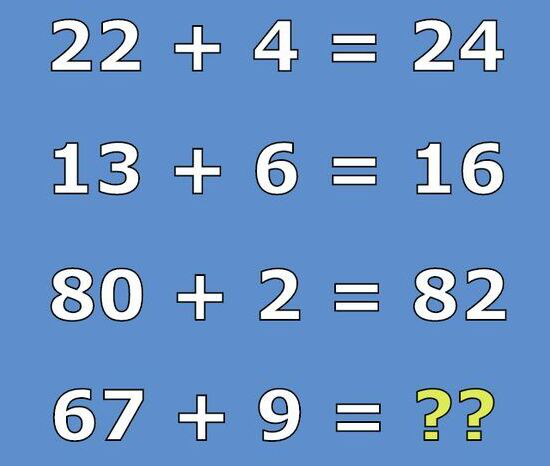
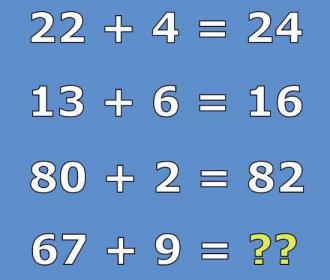
Mathematical Puzzle: IF 22+4...
[6406] Mathematical Puzzle: IF 22+4... - Mathematical Puzzle: IF 22+4=24, 13+6=16 and 80+2=82 THEN 67+9=? - #brainteasers #math #riddles - Correct Answers: 164 - The first user who solved this task is Nasrin 24 T
BRAIN TEASERS
enter your answer and press button OK

Mathematical Puzzle: IF 22+4...

Mathematical Puzzle: IF 22+4=24, 13+6=16 and 80+2=82 THEN 67+9=?
Correct answers: 164
The first user who solved this task is Nasrin 24 T.
#brainteasers #math #riddles
Register with your Google Account and start collecting points.
Check your ranking on list.

An amazing dog

There was this ad posted on the office window of an accounting firm :

"HELP wanted. Must be able to type 70 words per minute. Computer literacy is required. Must be bilingual. EQUAL EMPLOYER."

So there was this dog ambling outside the office. It noticed the ad and shuffled into the office to apply for the position. The employer took one look at the dog, shook his head and said "But I can't hire a dog."

The dog pointed at the words EQUAL EMPLOYER on the ad. So the employer said, "OK, can you first type this document?" and gave the dog a letter. The dog typed everything correctly and neatly without a mistake at a rate of 70 words per minute.

Flustered, the employer then said, "Then, can you put these figures into spreadsheet and make a program to feed it into the mainframe, process it in the General Ledger Module and give me the Balance Sheets and Profit and Loss Statement?" and gave the dog some documents. The dog completed the spreadsheet, the program, the Balance Sheet and the P/L statement promptly & correctly.

The employer shook his head, pointed at the ad and said, "But are you bilingual?"

The dog said "Meow!"

Jokes of the day - Daily updated jokes. New jokes every day.
Follow Brain Teasers on social networks

Brain Teasers

puzzles, riddles, mathematical problems, mastermind, cinemania...

Sir Samuel Bentham

Died 31 May 1831 at age 74 (born 11 Jan 1757).British engineer, naval architect, and navy official in Russia (1780-91) and England (from 1795) who was an early advocate of explosive-shell weapons for warships. In 1780, he was sent by the Admiralty to visit dockyards in Northern Europe. In Russia he improved management of Prince Potemkin's factories. While he was in Russia he built and equipped a flotilla of ships and distinguished himself in a victorious naval battle with the Turks. Using special guns that he had built and mounted in the ships, shells were fired for the first time in naval warfare. There also, he began his ideas for machines which worked by unskilled labour, could produce the same results as skilled workmen.
This site uses cookies to store information on your computer. Some are essential to help the site properly. Others give us insight into how the site is used and help us to optimize the user experience. See our privacy policy.