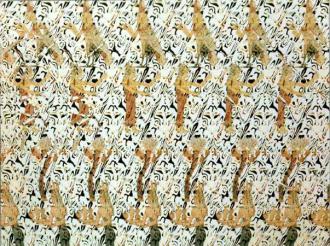
What hides this stereogram?
[6405] What hides this stereogram? - Stereogram - 3D Image - #brainteasers #stereogram #3Dimage
BRAIN TEASERS

What hides this stereogram?

Stereogram - 3D Image
#brainteasers #stereogram #3Dimage
Register with your Google Account and start collecting points.
Check your ranking on list.

Smart Cat

A man absolutely hated his wife's cat and decided to get rid of him one day by driving him 20 blocks from his home and leaving him at the park.
As he was getting home, the cat was walking up the driveway.
The next day he decided to drive the cat 40 blocks away. He put the beast out and headed home.
Driving back up his driveway, there was the cat!
He kept taking the cat further and further and the cat would always beat him home. At last he decided to drive a few miles away, turn right, then left, past the bridge, then right again and another right until he reached what he thought was a safe distance from his home and left the cat there.
Hours later the man calls home to his wife: "Jen, is the cat there?"
"Yes", the wife answers, "why do you ask?"
Frustrated, the man answered, "Put that son of a bitch on the phone, I'm lost and need directions!"

Jokes of the day - Daily updated jokes. New jokes every day.
Follow Brain Teasers on social networks

Brain Teasers

puzzles, riddles, mathematical problems, mastermind, cinemania...

Charles Martin Hall

Born 6 Dec 1863; died 27 Dec 1914 at age 51.American chemist who invented the inexpensive electrolytic method of extracting aluminium from its ore, enabling the wide commercial use of this metal. While a young chemist, he experimented in a woodshed, intent upon finding a method for separating aluminum from its ore. At first, he was unsuccessful, but then realized that he needed a nonaqueous solvent for the aluminum oxide during electrolysis. On 23 Feb 1886, Hall found that molten cryolite (the mineral sodium aluminum fluoride) was a suitable solvent and using carbon electrodes with home-made batteries, he produced his first small globules of aluminum. By 1914, Hall's process had brought the cost of aluminium, once a precious metal used for fine jewelry, down to 18 cents a pound.«
This site uses cookies to store information on your computer. Some are essential to help the site properly. Others give us insight into how the site is used and help us to optimize the user experience. See our privacy policy.