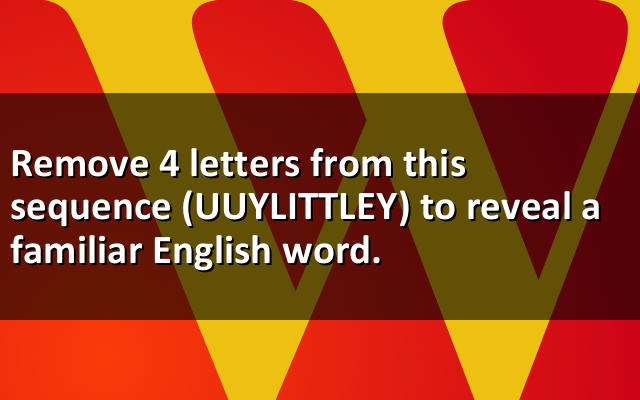
Remove 4 letters from this seq...
[4499] Remove 4 letters from this seq... - Remove 4 letters from this sequence (UUYLITTLEY) to reveal a familiar English word. - #brainteasers #wordpuzzles - Correct Answers: 57 - The first user who solved this task is Manguexa Wagle
BRAIN TEASERS
enter your answer and press button OK

Remove 4 letters from this seq...

Remove 4 letters from this sequence (UUYLITTLEY) to reveal a familiar English word.
Correct answers: 57
The first user who solved this task is Manguexa Wagle.
#brainteasers #wordpuzzles
Register with your Google Account and start collecting points.
Check your ranking on list.

International Day for Monuments and Sites/World Heritage Day jokes

Today is International Day for Monuments and Sites (World Heritage Day)! Find a joke about it!

Why the great pyramids are in Egypt?
Because they were too heavy to carry of to the British museum.

Why was Cleopatra angry?
She was on her pyramid.

I was offered a job building Egyptian tombs
Turned out to be a pyramid scheme

I'm surprised the tower of Pisa hasn't fallen over during the pandemic
Without all those tourists helping hold it up.

Two Americans are visiting Rome Colosseum
"Look at it. How huge and majestic it is."
"Just imagine how great it'll be when they finish building it."

Jokes of the day - Daily updated jokes. New jokes every day.
Follow Brain Teasers on social networks

Brain Teasers

puzzles, riddles, mathematical problems, mastermind, cinemania...

Alfred Bernhard Nobel

Died 10 Dec 1896 at age 63 (born 21 Oct 1833). Swedish chemist and inventor who invented dynamite and other, more powerful explosives. An explosives expert like his father, in 1866 he invented a safe and manageable form of nitroglycerin he called dynamite, and later, smokeless gunpowder and (1875) gelignite. He helped to create an industrial empire manufacturing many of his other inventions. Nobel amassed a huge fortune, much of which he left in a fund to endow the annual prizes that bear his name. First awarded in 1901, these prizes were for achievements in the areas of physics, chemistry, physiology or medicine, literature, and peace. The sixth prize, for economics, was instituted in his honour in 1969.
This site uses cookies to store information on your computer. Some are essential to help the site properly. Others give us insight into how the site is used and help us to optimize the user experience. See our privacy policy.