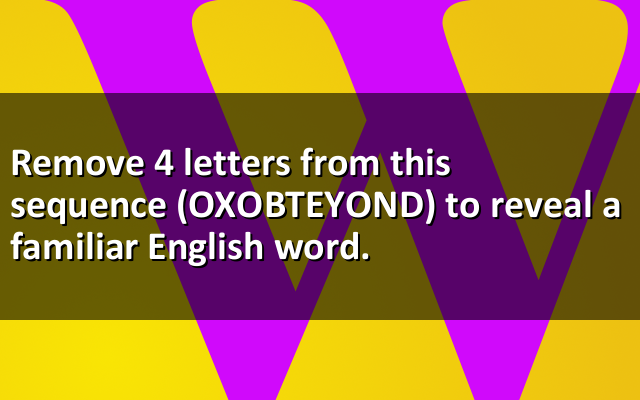
Remove 4 letters from this seq...
Remove 4 letters from this sequence (OXOBTEYOND) to reveal a familiar English word.Correct answers: 54
The first user who solved this task is Thinh Ddh.
#brainteasers #wordpuzzles

The supervisor for the Union O...
The supervisor for the Union Of Road Construction Workers called the meeting to order.
"Men -- we've agreed on a new deal with the state. We'll no longer have to work four days a week!"
"HOORAY!!!" the crowd cheered.
"We'll quit work at 4PM and not 5PM!"
"HOORAY!!!" the crowd roared.
"We don't have to be in until 11AM instead of 10AM!"
"HOORAY!!!" the crowd thundered.
"And now, even though 99% of the roads in the country are blocked by orange barrels, we'll only have to work on Wednesdays!!"
Silence.
A voice from the back of the room asks, "You mean, EVERY Wednesday?"
"Men -- we've agreed on a new deal with the state. We'll no longer have to work four days a week!"
"HOORAY!!!" the crowd cheered.
"We'll quit work at 4PM and not 5PM!"
"HOORAY!!!" the crowd roared.
"We don't have to be in until 11AM instead of 10AM!"
"HOORAY!!!" the crowd thundered.
"And now, even though 99% of the roads in the country are blocked by orange barrels, we'll only have to work on Wednesdays!!"
Silence.
A voice from the back of the room asks, "You mean, EVERY Wednesday?"