
Remove 4 letters from this seq...
[5617] Remove 4 letters from this seq... - Remove 4 letters from this sequence (IQOQUESTIAON) to reveal a familiar English word. - #brainteasers #wordpuzzles - Correct Answers: 49 - The first user who solved this task is Nílton Corrêa De Sousa
BRAIN TEASERS
enter your answer and press button OK

Remove 4 letters from this seq...

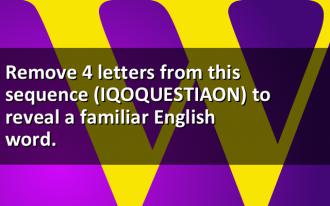
Remove 4 letters from this sequence (IQOQUESTIAON) to reveal a familiar English word.
Correct answers: 49
The first user who solved this task is Nílton Corrêa De Sousa.
#brainteasers #wordpuzzles
Register with your Google Account and start collecting points.
Check your ranking on list.

We don't stop at Victoria....

A man traveling by train asks the ticket collector what time the train stops at Victoria.

"Sir, we don't stop at Victoria."

"But I have to get off there!"

"Well, there might be one thing I can do. I might be able to get the engineer to slow down the train a little. Then I can dangle you out the door and lower you onto the platform."

"Will that work?"

"It's worth a try."

As they approached the platform, the train is slowing from 50 MPH. The collector hangs the man in mid-air out the door. The man starts running in mid-air. "Run faster! Faster!" He lowers the man and the man's feet touch the platform. His shoes start to smoke! His heel comes off! He's running at 30 MPH. He's made it! He starts to slow down! The other passengers stare in amazement.

As the last car goes by, a hand grabs the man by the shirt collar and lifts the man right back into the train! As he's helped back on the train the gent who picked him up says, "Man you're lucky I was here to help! This train doesn't even STOP in Victoria!"

Jokes of the day - Daily updated jokes. New jokes every day.
Follow Brain Teasers on social networks

Brain Teasers

puzzles, riddles, mathematical problems, mastermind, cinemania...

Sir Thomas Edward Thorpe

Born 8 Dec 1845; died 23 Feb 1925 at age 79. English chemist and author whose work in inorganic chemistry included the supervision of research into determining the presence of arsenic in beer and how to make pottery glazes without lead. In his early studies, while a chemistry student under Roscoe, he became a research assistant in his pioneering research work on vanadium, and the determination of its atomic weight. After graduation he worked first with Bunsen and then Kekulé. He then spent time teaching at the Royal College of Science, London (which became Imperial College). Later in life, he was director of the government laboratories (1894-1909). His research included study of phosphorus fluorides and oxides, in which he discovered the valence of five for phosphorus in phosphorus pentafluoride. As well as textbooks in chemistry, he wrote about chemistry history.«
This site uses cookies to store information on your computer. Some are essential to help the site properly. Others give us insight into how the site is used and help us to optimize the user experience. See our privacy policy.