
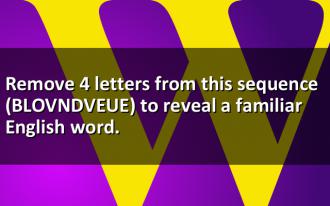
Remove 4 letters from this seq...
[6580] Remove 4 letters from this seq... - Remove 4 letters from this sequence (BLOVNDVEUE) to reveal a familiar English word. - #brainteasers #wordpuzzles - Correct Answers: 27 - The first user who solved this task is Nasrin 24 T
BRAIN TEASERS
enter your answer and press button OK

Remove 4 letters from this seq...

Remove 4 letters from this sequence (BLOVNDVEUE) to reveal a familiar English word.
Correct answers: 27
The first user who solved this task is Nasrin 24 T.
#brainteasers #wordpuzzles

Register with your Google Account and start collecting points.
Check your ranking on list.

A wealthy man was having an af...

A wealthy man was having an affair with an Italian woman for several months. One night, during one of their rendezvous, she confided in him that she was pregnant. Not wanting to ruin his reputation or his marriage, he paid her a large sum of money if she would go to Italy to secretly have the child. If she stayed in Italy to raise the child, he would also provide child support until the child turned 18. She agreed, but asked how he would know when the baby was born. To keep it discreet, he told her simply to mail him a post card, and write "Spaghetti" on the back. He would then arrange for child support payments to begin.
One day, about 9 months later, he came home to his confused wife. "Honey," she said, "you received a very strange post card today."
"Oh, just give it to me and I'll explain it," he said.
The wife obeyed, and watched as her husband read the card, turned white, and fainted.
On the card was written: "Spaghetti, Spaghetti, Spaghetti. Two with meatballs, one without."
Jokes of the day - Daily updated jokes. New jokes every day.
Follow Brain Teasers on social networks

Brain Teasers

puzzles, riddles, mathematical problems, mastermind, cinemania...

Martin Rodbell

Born 1 Dec 1925; died 7 Dec 1998 at age 73.American biochemist who was awarded the 1994 Nobel Prize for Physiology or Medicine for his discovery in the 1960s of natural signal transducers called G-proteins that help cells in the body communicate with each other. He shared the prize with Alfred G. Gilman, who later proved Rodbell's hypothesis, by isolating the G-protein, which is so named because it binds to nucleotides called guanosine diphosphate and guanosine triphosphate, or GDP and GTP. Prior to Rodbell's research, scientists believed that only two substances—a hormone receptor and an interior cell enzyme—were responsible for cellular communication. Rodbell, however, discovered that the G-protein acted as an intermediate signal transducer between the two.
This site uses cookies to store information on your computer. Some are essential to help the site properly. Others give us insight into how the site is used and help us to optimize the user experience. See our privacy policy.