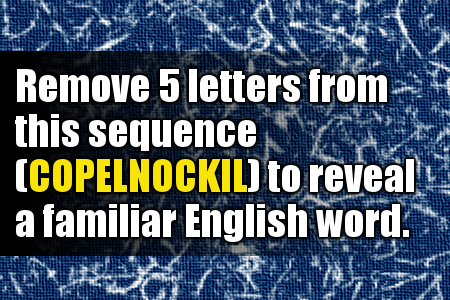
Remove 5 letters from this s...
[1894] Remove 5 letters from this s... - Remove 5 letters from this sequence (COPELNOCKIL) to reveal a familiar English word. - #brainteasers #wordpuzzles - Correct Answers: 63 - The first user who solved this task is Neelima Subrahmanyam
BRAIN TEASERS
enter your answer and press button OK

Remove 5 letters from this s...

Remove 5 letters from this sequence (COPELNOCKIL) to reveal a familiar English word.
Correct answers: 63
The first user who solved this task is Neelima Subrahmanyam.
#brainteasers #wordpuzzles
Register with your Google Account and start collecting points.
Check your ranking on list.

A very drunk gent checked into...

A very drunk gent checked into a hotel late one Saturday night. He awoke very ill and summoned a bellboy to fetch him a bottle of whiskey and a Sunday newspaper. The bellhop was gone a long time.
When he returned, the drunk remarked, "It must be hard to buy a bottle in this town on Sunday."
"There was no trouble with the whiskey," replied the bellboy, "but it's tough finding a Sunday paper on Tuesday."
Jokes of the day - Daily updated jokes. New jokes every day.
Follow Brain Teasers on social networks

Brain Teasers

puzzles, riddles, mathematical problems, mastermind, cinemania...

Friedrich Bergius

Died 30 Mar 1949 at age 64 (born 11 Oct 1884).Friedrich Karl Rudolf Bergius was a German chemist who invented a process to convert coal dust and hydrogen directly into gasoline and lubricating oils without isolating intermediate products (Stuttgart, 25 Jun 1921). Bergius succeeded, during distillation of coal, in forcing hydrogen under high pressure to combine chemically with the coal, transforming more carbon from the coal into oils than is possible with conventional distillation. To solve heat distribution and temperature regulation problems, Bergius invented treating a mixture of pulverized coal in oil with the gas under high pressure. For his work in developing the chemical high pressure hydrogenation method necessary for this process he shared the 1931 Nobel Prize for Chemistry with Carl Bosch of Germany.
This site uses cookies to store information on your computer. Some are essential to help the site properly. Others give us insight into how the site is used and help us to optimize the user experience. See our privacy policy.