Find the right combination
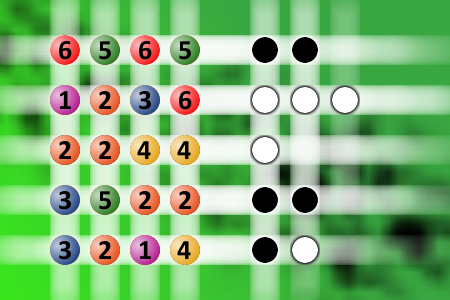
[1893] Find the right combination - The computer chose a secret code (sequence of 4 digits from 1 to 6). Your goal is to find that code. Black circles indicate the number of hits on the right spot. White circles indicate the number of hits on the wrong spot. - #brainteasers #mastermind - Correct Answers: 70 - The first user who solved this task is Djordje Timotijevic
BRAIN TEASERS
enter your answer and press button OK

Find the right combination

The computer chose a secret code (sequence of 4 digits from 1 to 6). Your goal is to find that code. Black circles indicate the number of hits on the right spot. White circles indicate the number of hits on the wrong spot.
Correct answers: 70
The first user who solved this task is Djordje Timotijevic.
#brainteasers #mastermind

Register with your Google Account and start collecting points.
Check your ranking on list.

Can I take his place?

An attorney telephoned the governor just after midnight, insisting that he talk to him regarding a matter of utmost urgency.

An aide eventually agreed to wake up the governor.

"So, what is it?" grumbled the governor.

"Judge Garber has just died" said the attorney, "and I want to take his place."

The governor replied: "Well, it's OK with me if it's OK with the undertaker."

Jokes of the day - Daily updated jokes. New jokes every day.
Follow Brain Teasers on social networks

Brain Teasers

puzzles, riddles, mathematical problems, mastermind, cinemania...

Robert John Kane

Died 16 Feb 1890 at age 80 (born 24 Sep 1809). Irish chemist whose book, The Industrial Resources of Ireland (1844), provided a study of the scientific and potential economic value of developing the country's natural resources. Kane began scientific research in his youth at his father's industrial chemicals factory. His first papers were published as a teenager. By the age of 22, he had already written a book, Elements of Practical Pharmacy, and was a professor of chemistry at Dublin's Apothecaries' Hall. In 1833, age 24, he published a paper in which he was the first to propose the existence of the -C2H5 ethyl radical (Dublin Journal of Medical and Chemical Sciences, which he founded). His research spanned inorganic, organic, physical, biological and applied chemistry.«
This site uses cookies to store information on your computer. Some are essential to help the site properly. Others give us insight into how the site is used and help us to optimize the user experience. See our privacy policy.