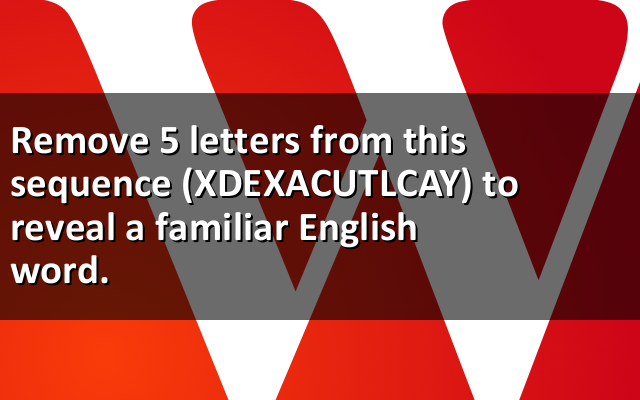
Remove 5 letters from this seq...
Remove 5 letters from this sequence (XDEXACUTLCAY) to reveal a familiar English word.Correct answers: 55
The first user who solved this task is Fazil Hashim.
#brainteasers #wordpuzzles

Jacob, age 92, and Rebecca, ag...
Jacob, age 92, and Rebecca, age 89, living in Florida, are all excited about their decision to get married. They go for a stroll to discuss the wedding, and on the way they pass a drugstore. Jacob suggests they go in.
Jacob addresses the man behind the counter: Are you the owner?
The pharmacist answers, Yes.
Jacob: Were about to get married. Do you sell heart medication?
Pharmacist: Of course we do.
Jacob: How about medicine for circulation?
Pharmacist: All kinds.
Jacob: Medicine for rheumatism and scoliosis?
Pharmacist: Definitely.
Jacob: How about Viagra?
Pharmacist: Of course.
Jacob: Medicine for memory problems, arthritis, jaundice?
Pharmacist: Yes, a large variety. The works.
Jacob: What about vitamins, sleeping pills, Geritol, antidotes for Parkinsons disease?
Pharmacist: Absolutely.
Jacob: You sell wheelchairs and walkers?
Pharmacist: All speeds and sizes.
Jacob: We would like to use this store as our Bridal Registry.
Jacob addresses the man behind the counter: Are you the owner?
The pharmacist answers, Yes.
Jacob: Were about to get married. Do you sell heart medication?
Pharmacist: Of course we do.
Jacob: How about medicine for circulation?
Pharmacist: All kinds.
Jacob: Medicine for rheumatism and scoliosis?
Pharmacist: Definitely.
Jacob: How about Viagra?
Pharmacist: Of course.
Jacob: Medicine for memory problems, arthritis, jaundice?
Pharmacist: Yes, a large variety. The works.
Jacob: What about vitamins, sleeping pills, Geritol, antidotes for Parkinsons disease?
Pharmacist: Absolutely.
Jacob: You sell wheelchairs and walkers?
Pharmacist: All speeds and sizes.
Jacob: We would like to use this store as our Bridal Registry.