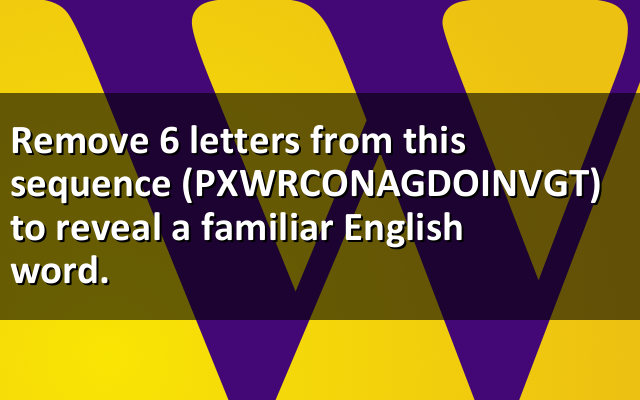
Remove 6 letters from this seq...
Remove 6 letters from this sequence (PXWRCONAGDOINVGT) to reveal a familiar English word.
Special golf ball
Two friends went out to play golf and were about to tee off, when one fellow noticed that his partner had just one golf ball.
“Don’t you have at least one other golf ball?” he asked.
The other guy replied that no, he only needed the one.
“Are you sure?” the friend persisted. “What happens if you lose that ball?”
The other guy replied, “This is a very special golf ball. I won’t lose it so I don’t need another one.”
"Well,” the friend asked, “what happens if you miss your shot and the ball goes in the lake?”
“That’s OK,” he replied, “this special golf ball floats. I’ll be able to retrieve it.”
“Well what happens if you hit it into the trees and it gets lost among the bushes and shrubs?”
The other guy replied, “That’s OK too. You see, this special golf ball has a homing beacon. I’ll be able to get it back -- no problem.”
Exasperated, the friend asks, “OK. Let’s say our game goes late, the sun goes down, and you hit your ball into a sand trap. What are you going to do then?”
“No problem,” says the other guy, “you see, this ball is florescent. I’ll be able to see it in the dark.”
Finally satisfied that he needs only the one golf ball, the friend asks, “Hey, where did you get a golf ball like that anyway?”
The other guy replies, “I found it.”