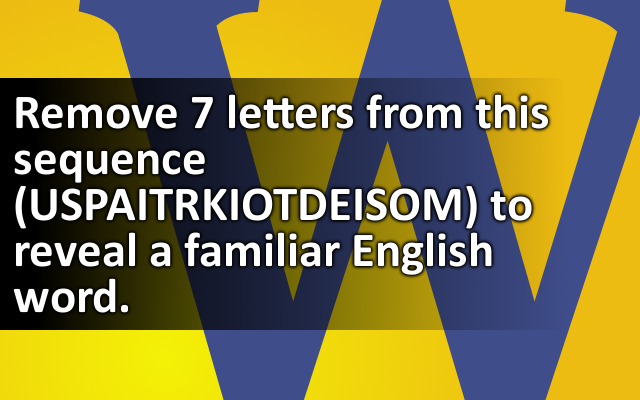
Remove 7 letters from this s...
Remove 7 letters from this sequence (USPAITRKIOTDEISOM) to reveal a familiar English word.
18 new Halloween jokes from 2020
Q: Where do ghosts buy their Halloween candy?
A: At the ghost-ery store!
Q: What do owls say when they go trick or treating?
A: Happy Owl-ween!
Q: What do ghosts give out to trick or treaters?
A: Booberries!
Q: Who did Frankenstein go trick or treating with?
A: His ghoul friend.
Q: What Halloween candy is never on time for the party?
A: Choco-LATE!
Q: Which type of pants do ghosts wear to trick or treat?
A: Boo jeans.
Q: What makes trick or treating with twin witches so challenging?
A: You never know which witch is which!
Q: What monster plays tricks on Halloween?
A: Prank-enstein!
Q: What fruit do scarecrows love the most?
A: Straw-berries.
Q: What does a witch use to do her hair?
A: Scarespray!
Q: What happens when a ghost gets lost in the fog?
A: He is mist.
Q:How do you fix a cracked pumpkin?
A: A pumpkin patch.
Q: Why don’t vampires have more friends?
A: Because they are a pain in the neck.
Q: What position does a ghost play in hockey?
A: Ghoulie.
Q: What do you give a vampire when he’s sick?
A: Coffin-drops.
Q: What is a ghost's nose full of?
A: Boooooogers!
Q: Have you heard how popular the local cemetery is?
A: People are just dying to get in.
Q: Why was the broom late?
A: It over swept.