
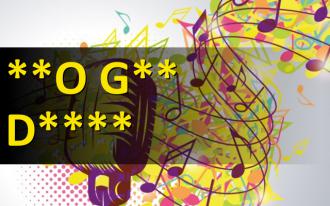
Replace asterisk symbols with ...
[5615] Replace asterisk symbols with ... - Replace asterisk symbols with a letters (**O G** D****) and guess the name of musician band. Length of words in solution: 3,3,5. - #brainteasers #music - Correct Answers: 17 - The first user who solved this task is Alfa Omega
BRAIN TEASERS
enter your answer and press button OK

Replace asterisk symbols with ...

Replace asterisk symbols with a letters (**O G** D****) and guess the name of musician band. Length of words in solution: 3,3,5.
Correct answers: 17
The first user who solved this task is Alfa Omega.
#brainteasers #music
Register with your Google Account and start collecting points.
Check your ranking on list.

Send me your ...

The wife, being a romantic at heart, decided one day that she’d send her husband a text while she was out having coffee with a friend. She texted:

If you are sleeping, send me your dreams.
If you are laughing, send me your smile.
If you are eating, send me a bite.
If you are drinking, send me a sip.
If you are crying, send me your tears.
I love you.

The husband, being a no-nonsense sort of guy, texted back:

I’m on the toilet.
Please advise.

Jokes of the day - Daily updated jokes. New jokes every day.
Follow Brain Teasers on social networks

Brain Teasers

puzzles, riddles, mathematical problems, mastermind, cinemania...

Sir William Herschel

Died 25 Aug 1822 at age 83 (born 15 Nov 1738). German-born British astronomer, the founder of sidereal astronomy for the systematic observation of the heavens. In 1773, Herschel made and began using his first telescope. With it he began a project that would continue for the rest of his life: that of systematically studying the sky. Through this study he discovered the planet Uranus, many new nebulae, clusters of stars and binary stars. Herschel hypothesized that nebulae are composed of stars, developed a theory of stellar evolution and was the first person to correctly describe the form of our Galaxy, the Milky Way. He discovered the Saturnian satellites Mimas and Enceladus (1789) and the Uranian satellites Titania and Oberon (1787). He was probably the most famous astronomer of the 18th century.
This site uses cookies to store information on your computer. Some are essential to help the site properly. Others give us insight into how the site is used and help us to optimize the user experience. See our privacy policy.