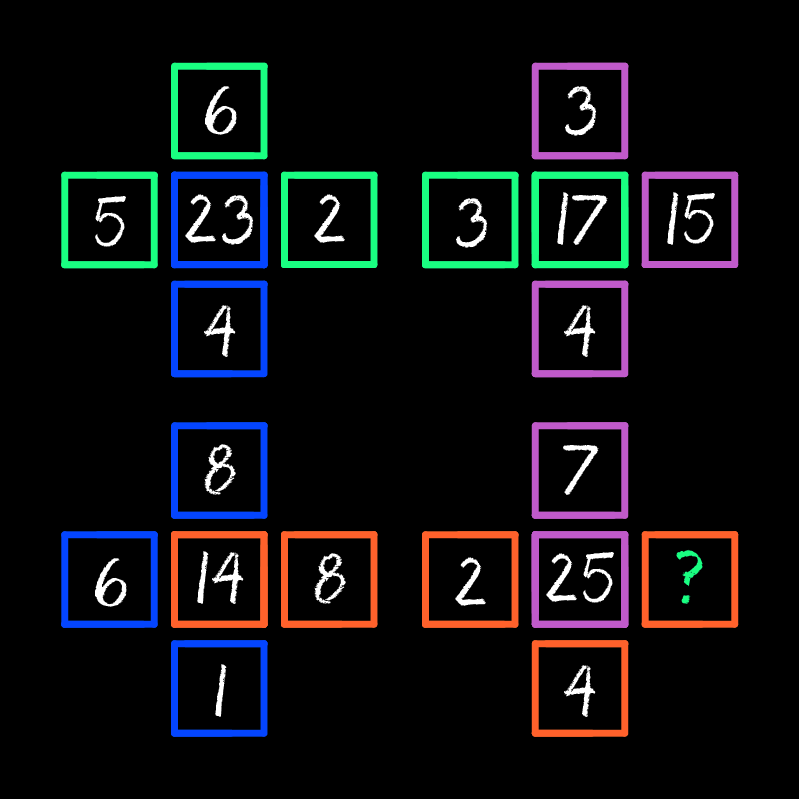

Replace the question mark with a number
[3030] Replace the question mark with a number - MATH PUZZLE: Can you replace the question mark with a number? - #brainteasers #math #riddles - Correct Answers: 228 - The first user who solved this task is Maryam Pouya
BRAIN TEASERS
enter your answer and press button OK

Replace the question mark with a number

MATH PUZZLE: Can you replace the question mark with a number?
Correct answers: 228
The first user who solved this task is Maryam Pouya.
#brainteasers #math #riddles
Register with your Google Account and start collecting points.
Check your ranking on list.

10 Fresh Jokes for a Midweek Laugh

I was once served French pancakes in a haunted house…
They gave me the crepes!

Dentist: "That's the biggest cavity I've ever seen. That's the biggest cavity I've ever seen."
Patient: "I heard you the first time. You didn't have to say it twice."
Dentist: "I didn't. That was my echo."

I got fired from Pepsi after working there for 20 years.
I tested positive for coke.

Dung beetle walks into a bar....
"Is this stool taken?"

What do you call a man with a toe on his knee?
Tony.

It's ironic how funeral directors have raised the price of funerals.
And blamed it on cost of living.

Save money when buying a coffin…
Buy a pen from Amazon and use the box it came in!

I wonder what Jeff Bezos does before he goes to bed.
Probably puts his pyjamazon.

I paid $500 for a belt.
It was a huge waist.

My girlfriend has always said that I'm not a romantic.
So I surprised her and proposed to her in a castle.
You would think she would have been happy
but for the look on her face as we were bouncing around........

Jokes of the day - Daily updated jokes. New jokes every day.
Follow Brain Teasers on social networks

Brain Teasers

puzzles, riddles, mathematical problems, mastermind, cinemania...

Guncotton patent

In 1846, Christian Frederick Schönbein of Basle, Switzerland, was issued a U.S. Patent for guncotton titled “Improvement in Preparation of Cotton-Wool and Other Substances as Substitutes for Gunpowder”(No. 4874). The process uses a mixture of concentrated acids to convert the cellulose present in well-cleaned cotton-wool, C6H10O5 into cellulose nitrate C6H8(NO2)2O5 (nitrocellulose). In 1891, James Dewar and Frederick Abel incorporated nitrocellulose in a mixture that could be handled more safely. Until WW II, this invention replaced gunpower on the battlefield, where it had been used for five centuries. It was also useful for blasting because it generates about six times the gas of an equal volume of gunpowder and produces less smoke and heat.
This site uses cookies to store information on your computer. Some are essential to help the site properly. Others give us insight into how the site is used and help us to optimize the user experience. See our privacy policy.